PAST THE LIST,
PAST THE DOOR
Inside Lucky Tree’s Monday Night Music Community


ORIGINAL STORIES, OBSERVATIONS, AND THINGS I CAN'T STOP THINKING ABOUT.
ORIGINAL FEATURES, ESSAYS AND STORIES — REPORTED, WRITTEN AND PHOTOGRAPHED BY SARAH MULU.
 RALEIGH, N.C. / LIVE MIC
Inside Lucky Tree’s Monday Night Music Community
MUSIC / ART / COMMUNITY
Inside Lucky Tree’s Monday Night Music Community
Before anyone reaches the microphone at Lucky Tree, the music has already escaped the room.
Outside the Raleigh cafe, people gather on wooden benches beneath the darkening sky. A rusted metal sculpture shaped like a drum kit sits nearby, surrounded by chalk drawings that range from wandering chicken scratch to pictures intricate enough to make someone stop walking. A few feet away, another kind of drawing begins in sound. Rappers collect in loose circles, trading verses through impromptu cyphers and rap battles. One voice throws out a line. Another catches it, answers and passes the rhythm on.
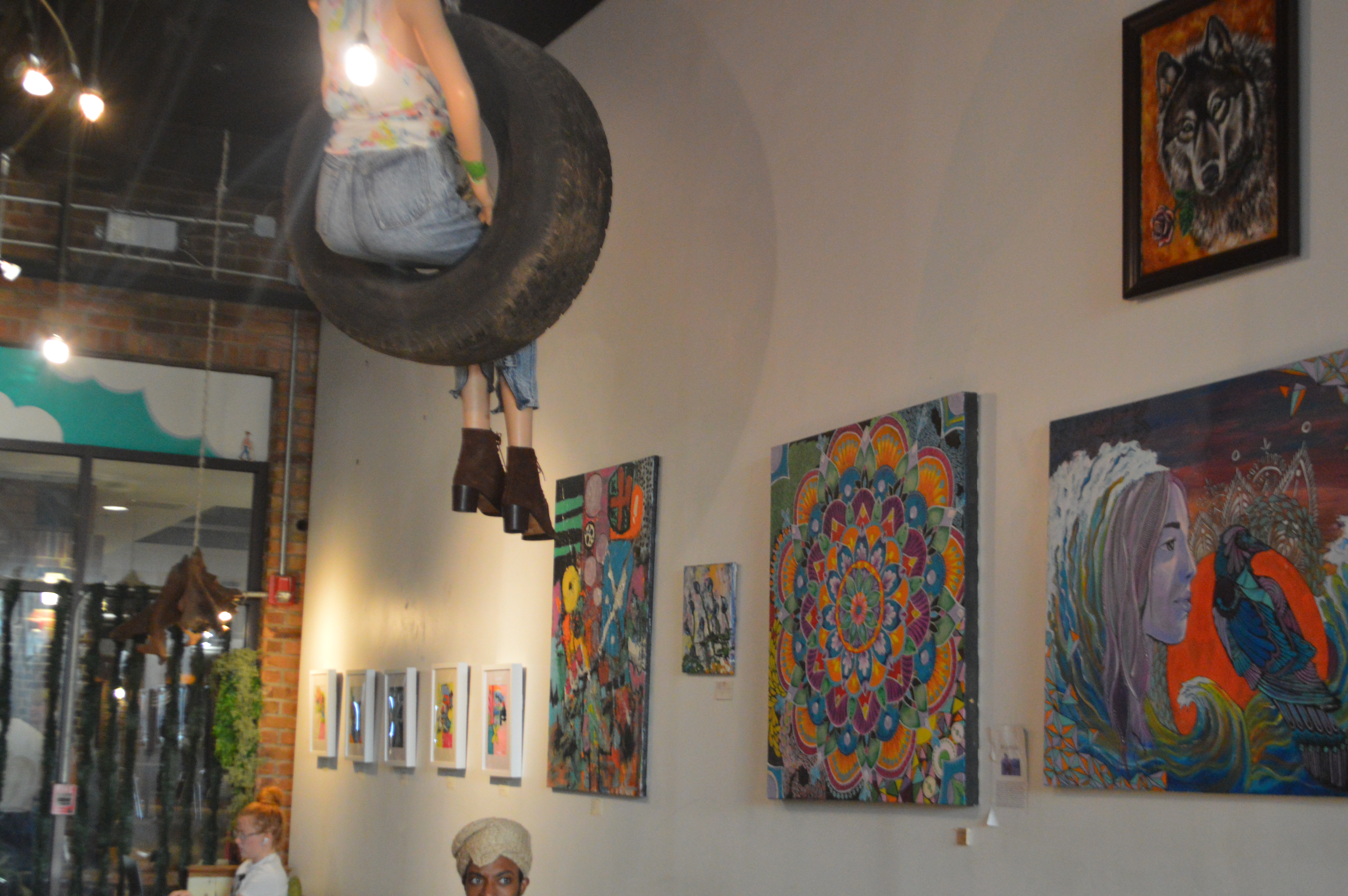
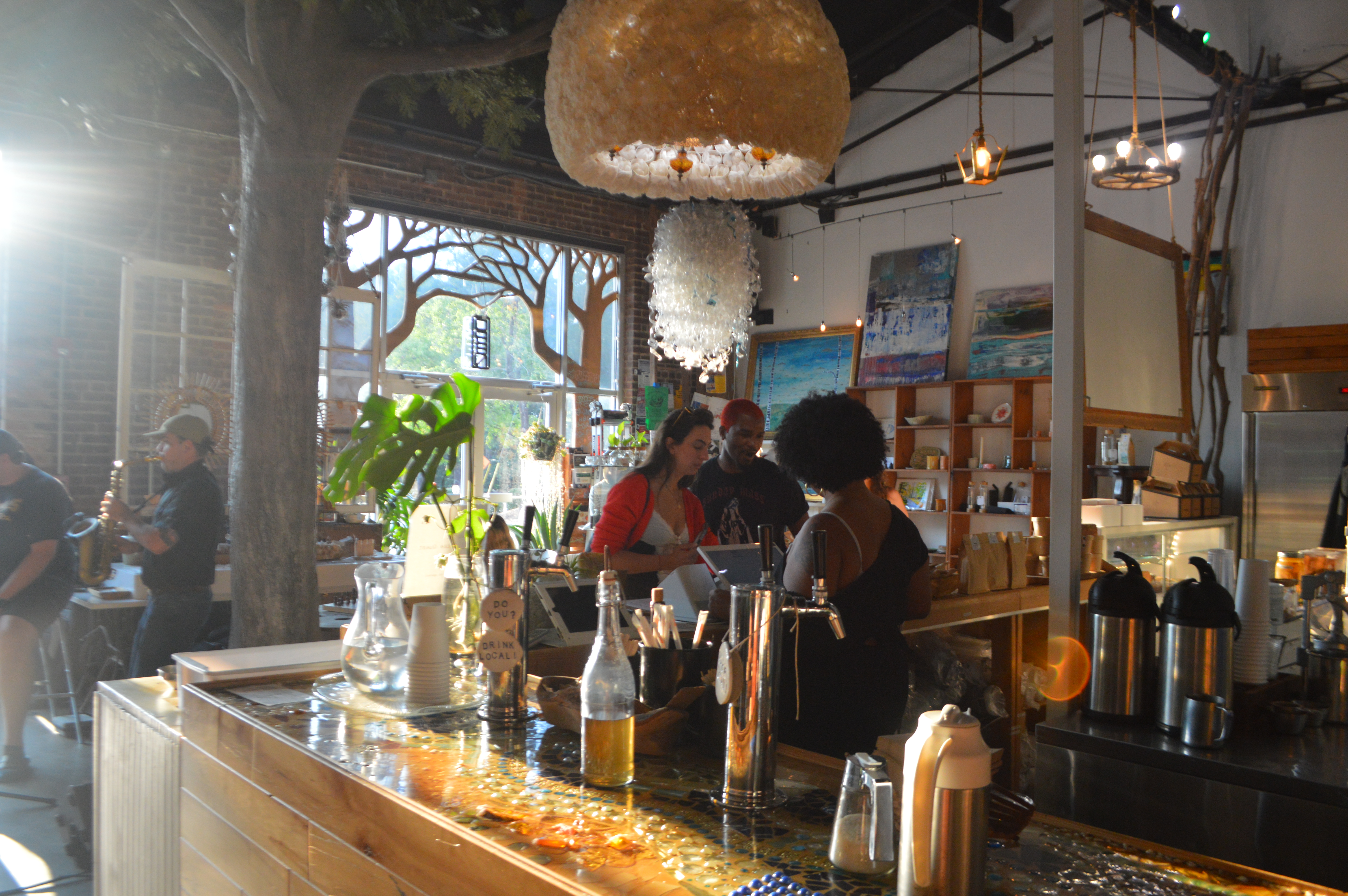
Through the cafe doors, there is hardly an empty surface. Local artwork climbs the walls and continues overhead, where paintings and odd sculptures compete with decorative light fixtures for the last patches of ceiling. A mannequin sits suspended on a swing. Bodies press between tables. Drinks and pastries move across the counter, joined at night by beer and wine. Toward the back, a man bends over an outstretched hand, painting free henna into the skin.
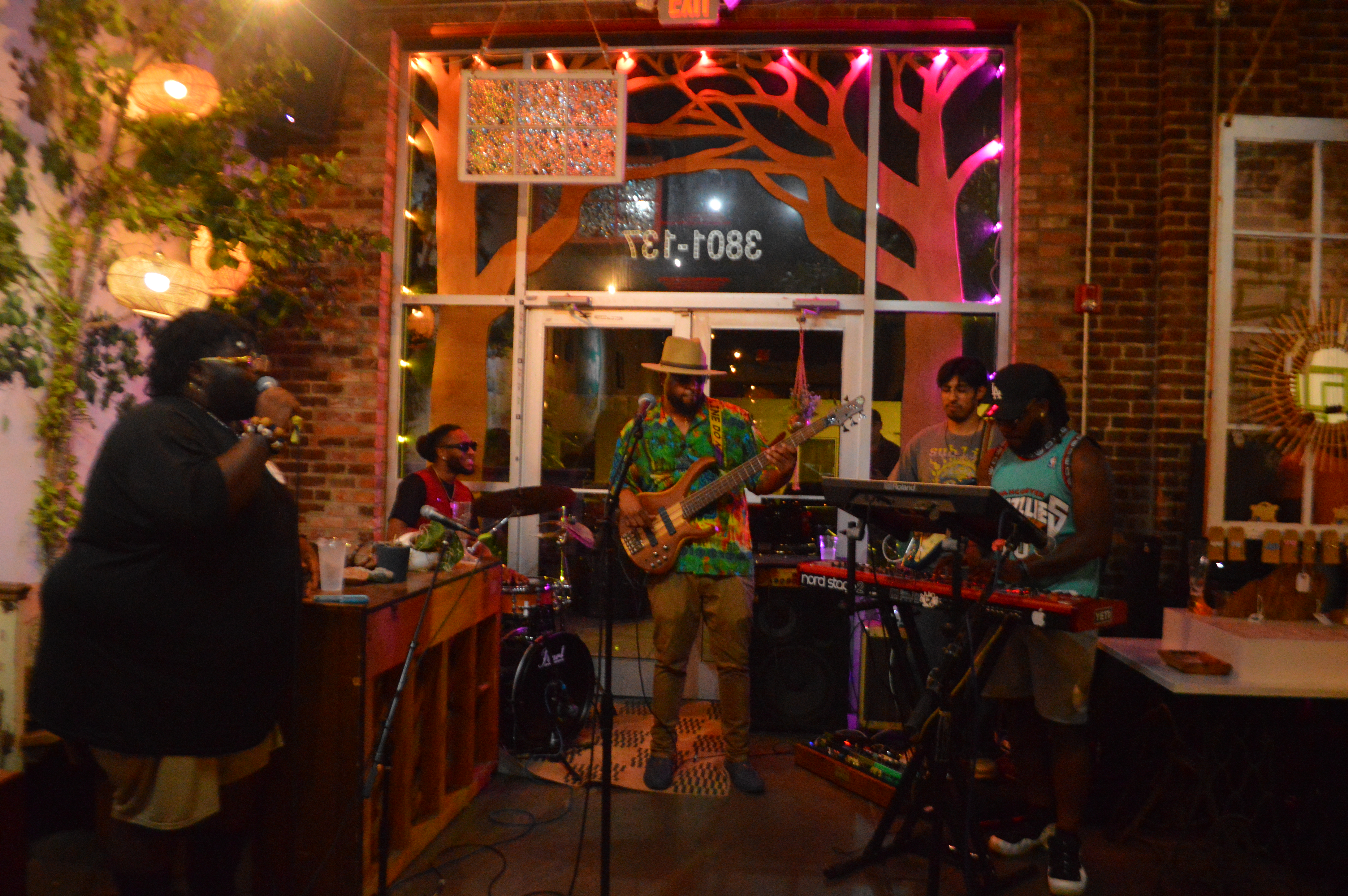
At the front, cables curl across the floor between microphones, speakers and instruments. Musicians drift in and out as they are needed, stepping into songs they may not have rehearsed and sometimes have never heard. To the left, Jackson works the soundboard from a post that doubles as another instrument. His seat is a drum. Without leaving the controls, he can lean into the rhythm.
At the microphone is Donnie Deneil.

He is MCing tonight, introducing performers and carrying the room through the pauses between them. Then his own voice enters — soulful, elastic, moving between pop, rock and R&B.
Around him, the usual divisions of a venue begin to blur. People dance in the narrow spaces left open. Strangers exchange social media accounts. Old friends lean toward one another in corners. Some step outside to smoke, where the cyphers continue beneath conversations and passing traffic, then slip back through the door when they hear something they do not want to miss.
There is a jam midway through Live Mic. There is another after every name on the list has been called. By then, the structure of the night has started to loosen. A person who came to watch can move closer. Someone who arrived too late to sign up can still find a microphone. A musician begins a progression, and other people enter it one instrument, one voice, one instinct at a time.
For Deneil, that opening once made the difference between going home unknown and finding what he now calls family.
He first came to Live Mic in October 2022 after a friend told him about it. She was supposed to meet him there but never showed. Deneil had also invited his friend and Duck bandmate Chris, who canceled.
He could leave, or he could walk into an unfamiliar room alone.
“You know what? Fuck it. I’ma go anyway,” Deneil remembered thinking.
He had moved from Wilmington in November 2019 and was still trying to find his place in Raleigh’s live music scene. He had been visiting open mics around the area, but when he entered Lucky Tree that night, every face was new.
“I didn’t know anybody at the time,” he said.
He was also too late to put his name on the performance list.
Then the end jam began.
Deneil sang.
“And then I just started going,” he said.
Nearly four years later, he sometimes stands at the front of that same room as its MC. The strangers he met there have become some of his closest friends.
“I consider them family,” he said.
Most open mics, Deneil said, are more rigid. There is a list, a sequence and an ending. Lucky Tree makes room for music at the beginning, middle and end — room for whatever the list could not predict.
“The jam is for the folks who didn’t make it on the list, didn’t get a chance to sign up, but they still have an opportunity to get on the mic and bust a move,” Deneil said.
The list decides who performs first.
It does not decide who belongs.
People arrive at Lucky Tree by different routes.
Some hear about Live Mic from a friend. Some follow the cafe online for years before gathering the nerve to walk through its doors. Some type a few words into Google and let the search bar lead them there.
That was how Isabelle Henderson found it.
Henderson grew up in Raleigh but had been living in Columbus, Ohio, where she attended school. When she returned to the area in January, she wanted to enter the local music scene rather than merely live near it. A search brought her to Lucky Tree. Within only a few visits, the cafe had redrawn her map of the city.
“Almost everyone I know in the Raleigh music scene I’ve met here,” Henderson said.

Henderson, 22, has written songs since high school. She began with piano, then reached toward other instruments. Her first stringed instrument was a mandolin. She walked into a Guitar Center, picked one up and recognized something in it immediately.
“This feels like me,” she remembered thinking.
For years, much of Henderson’s energy had gone into intensive ballet training. When an injury ended that chapter, music became somewhere else for the feeling to go. She describes it as cathartic — a release for what her body once translated through dance. Now studying digital media and design and psychology online at Southeastern University, she continues to build her musical life beyond a formal conservatory or program.
Community, however, cannot be practiced alone.
Henderson has spent time in other music scenes and at other open mics, where artists can seem to watch one another through a thin film of competition. At Lucky Tree, she felt that film dissolve.
“Everyone is here to experience each other’s art and share with each other and support each other,” Henderson said.
That support, she said, has made the cafe “very instrumental to the Raleigh music scene — no pun intended.”
For Perm Bryan, arriving took years.
Bryan, whose birth name is Evelin Kembe, was born and raised in Raleigh. She studied theater at N.C. A&T in Greensboro, lived in Asheville and moved to New York before eventually returning home. Even while she was elsewhere, Lucky Tree remained on her phone — a place she watched through Instagram and through the posts of local musicians.
“I’ve been following the Instagram page for I don’t know how many years now,” Bryan said.
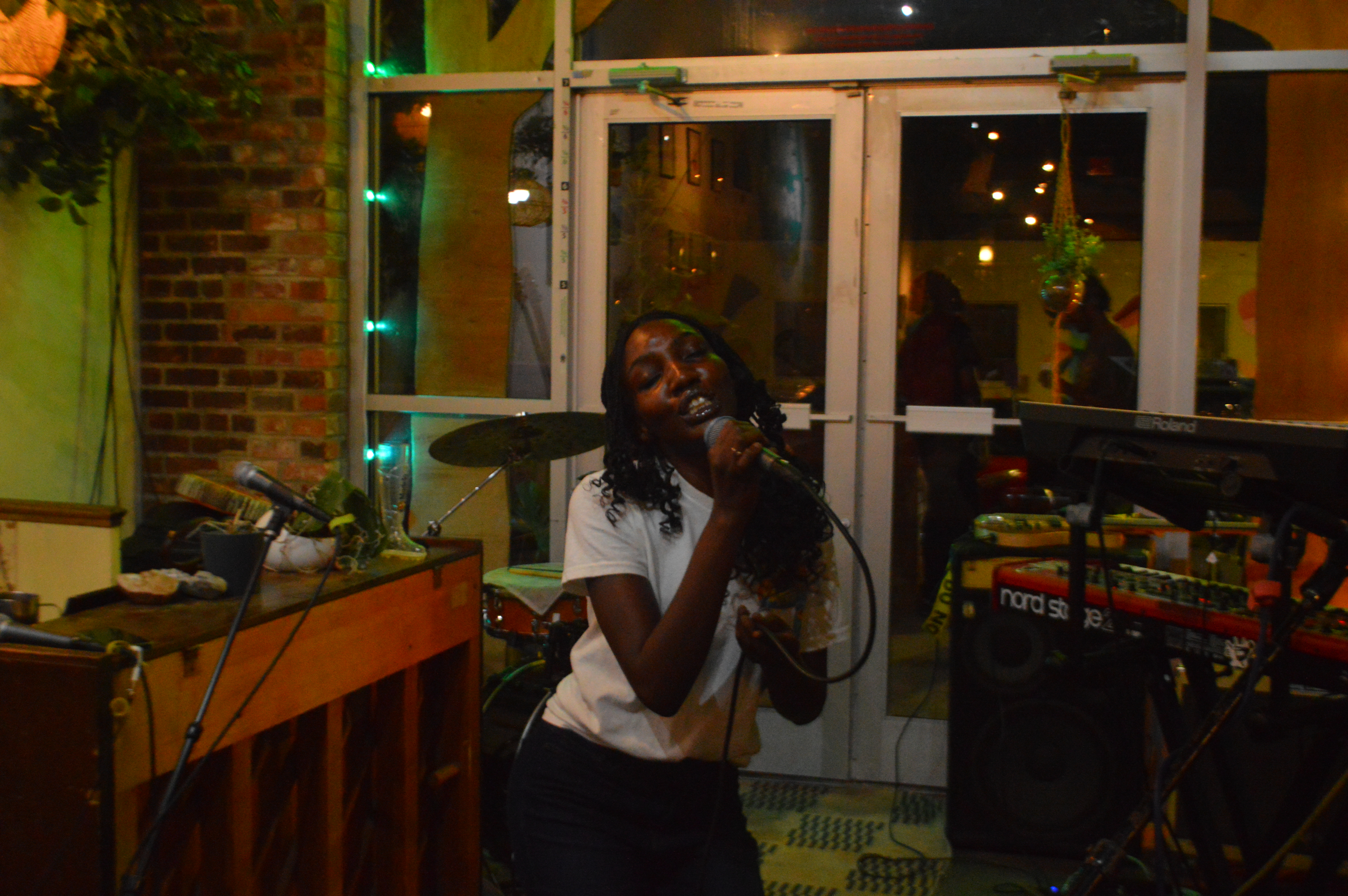
The cafe was familiar as an image: art packed against the walls, performers at the microphone, faces gathered close. Still, she kept postponing the actual visit. After she moved back to Raleigh, curiosity began to feel more like insistence.
“Oh my God, something has to lead me here,” she remembered thinking.
Her first visit was only a week before she was interviewed.
She had already returned.
The artwork drew her eye. The unusual interior gave her something to study. Neither brought her back.
“It’s more so the people,” Bryan said. “Like, if I didn’t fuck with y’all the last time, I would not be back.”
Unfamiliar rooms can be difficult for Bryan. She described herself as anxious around people she does not know, conscious of the invisible rules that seem to govern how a newcomer should stand, speak or enter a conversation. At Lucky Tree, she said, people met her with warmth before she had time to retreat into herself.
That welcome reaches into a longer struggle over her own voice.
Bryan grew up singing and performing in theater. Her father is also a musician, better known in South Sudan, where her family is from. Yet singing for most of her life did not mean trusting the sound that came out.
“I’ve always wanted to sing, but I never really liked my voice,” Bryan said.
She spent years listening to artists she admired and bending toward them, trying to borrow their sound and perhaps some of their certainty. More recently, she has begun moving the other way — back toward whatever is unmistakably hers.
“I realize individuality is really important,” Bryan said.
She writes her own songs and has produced the music she has released, though she is still reluctant to call herself a producer. At Lucky Tree, individuality is not something she has to discover in isolation. It is everywhere: in the rapper building a verse outside, the singer testing an original song inside, the musician stepping into another person’s work without swallowing it.
“It’s very positive here, and everyone very obviously supports each other, which is beautiful,” Bryan said.
Other creative spaces have carried what she calls “mean-girl energy.” Lucky Tree did not.
“It feels very beautiful. It feels warm,” she said. “It’s giving more of a kind of familial vibe.”
Bryan had been coming for days. Henderson, for months. Deneil, for years. Time had not flattened their experiences into the same story, but each had crossed the same small threshold: arriving without the community they wanted, then finding pieces of it crowded into one cafe.
For Henderson, the feeling becomes clearest after the formal performances begin to fall away. The people who came mainly to network start to leave. The room grows smaller. Individual acts dissolve into musicians playing together.
Then, she said, “it’s literally just the music.”
“It’s just the vibes,” Henderson said, “and it always reaches that second plane that music only can reach.”
Jade Gomez does not come to Live Mic to perform.
She comes with her cousin Ariana, who sometimes does, and stays on the audience’s side of the microphone. From there, she watches the room reorganize itself around every new voice.
“I enjoy watching all the people,” Gomez said. “I enjoy watching all the performances.”
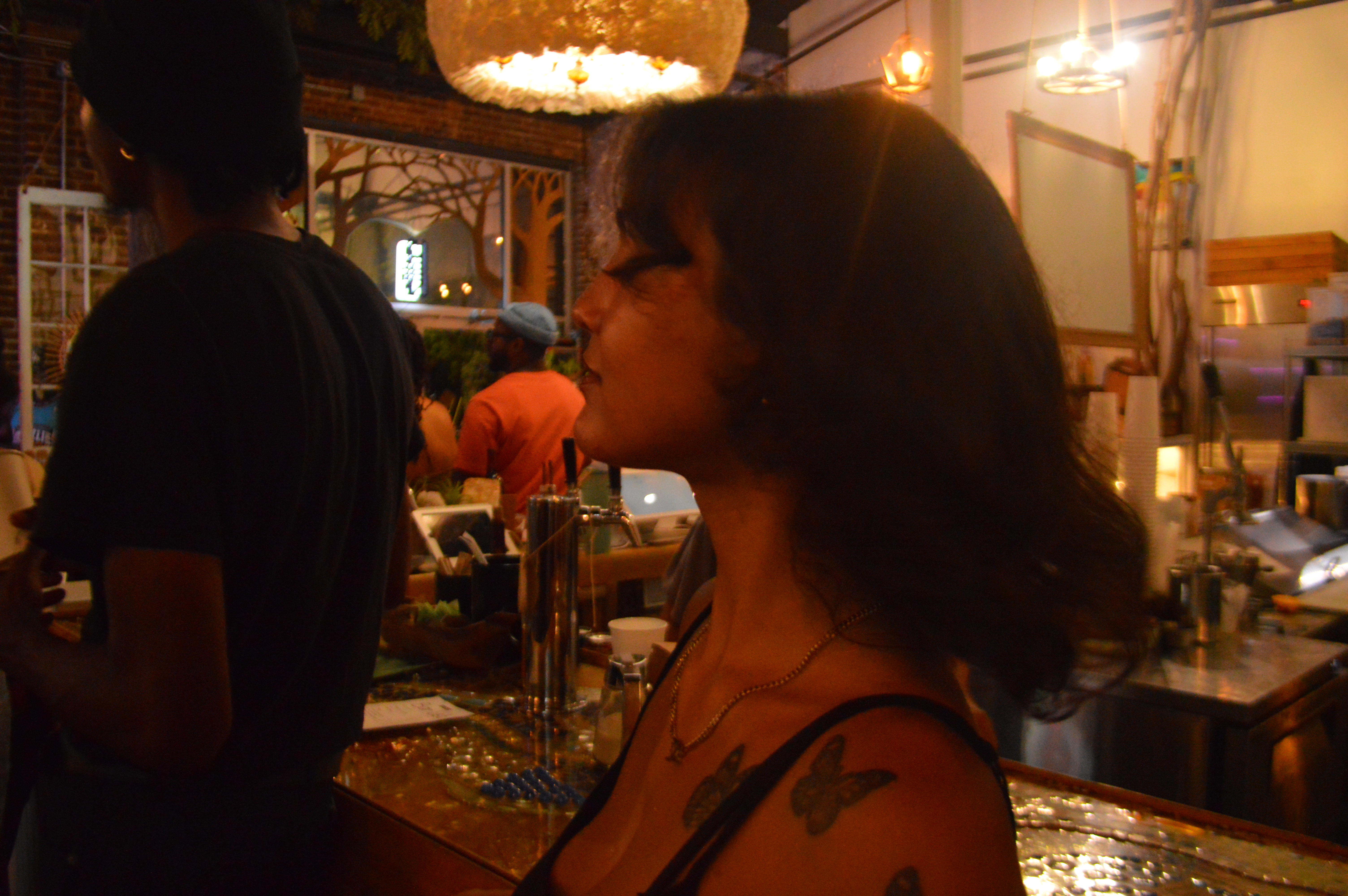
Listening can appear passive only from a distance. Inside the cafe, the audience gives a performance its temperature. A cheer can loosen someone’s shoulders. A nod from the right stranger can carry an uncertain singer through the next line. Applause fills the brief, exposed silence after a final note.
Gomez returns because she wants to be part of that exchange.
“Everyone’s very nice and genuine and welcoming, too,” she said. “So it’s a awesome community. I enjoy it.”
At Lucky Tree, no one merely watches. Not really.
The jam makes that truth visible. Unlike the scheduled performances, it has no neat boundary around who prepared, who registered or who was supposed to be heard that night. A late arrival can enter. Musicians can join one another. Someone listening near the back can become part of the sound before deciding whether to call it a performance.
“There are not a lot of open mics where they’ll have a beginning jam and then a mid jam and then an end jam,” Deneil said.
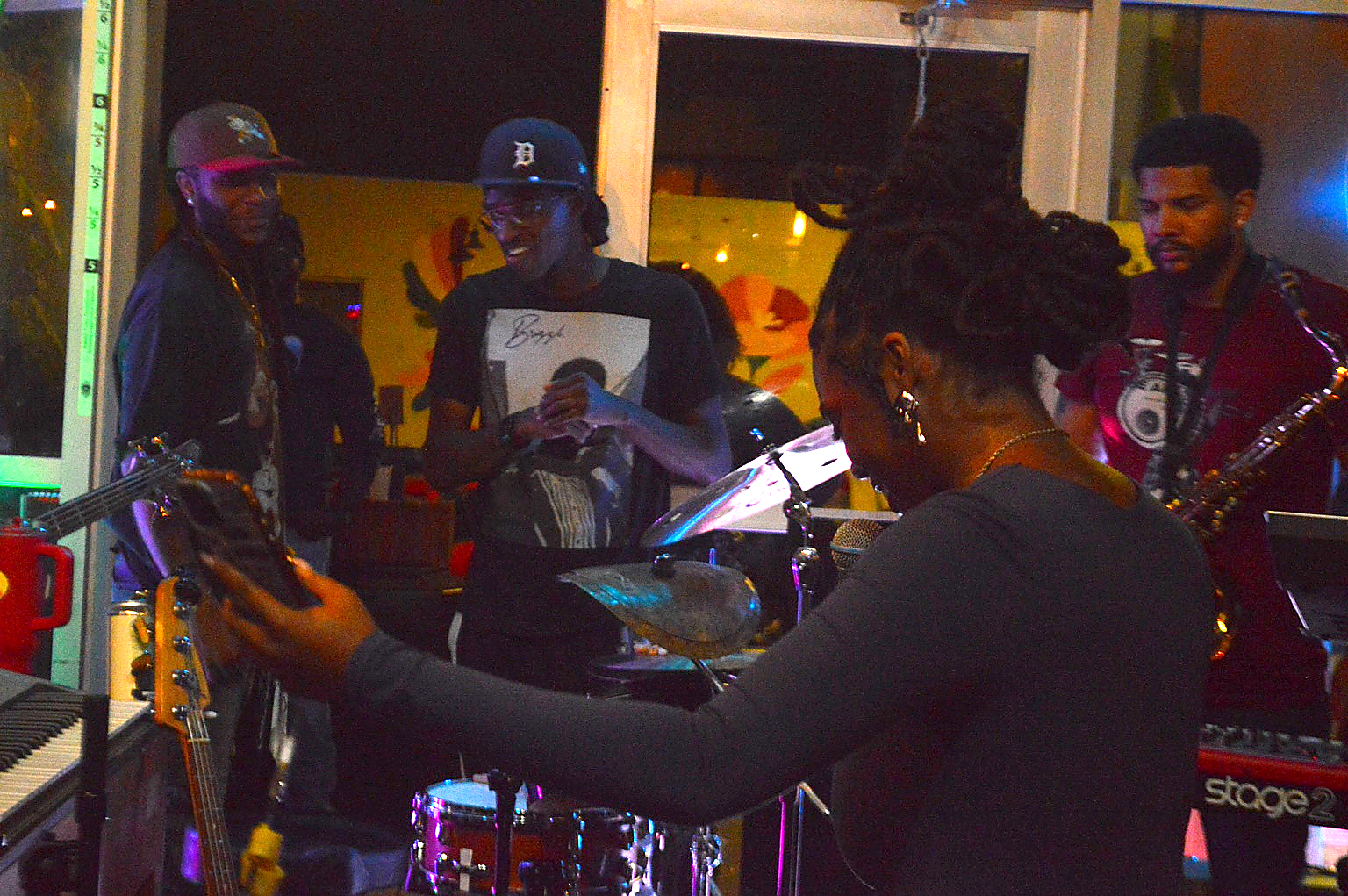
The cyphers outside follow a similar law. One person begins, but the circle survives through response. A verse calls for another verse. The person waiting at the edge becomes the next voice in the center. What looks spontaneous still depends on trust: the belief that someone will catch the beat when it is passed.
Sometimes, Deneil said, his favorite moments are “when there’s just good shit back to back to back.”
He listens not only for the performances but for what rises around them.
“You hear the people support it and, you know, just rock with what they’re doing,” he said.
Ashley Faries, one of Lucky Tree’s owners, watches that support from the perspective of someone who helped create the room. She and her family were not musicians when they began making space for music. Lucky Tree already offered walls to visual artists. They wanted musicians to have an outlet of their own.
The idea for Live Mic did not arrive as one person’s grand invention, Faries said. It emerged through a family brainstorm about what kind of community event the space could hold.
“We knew that we wanted to create that outlet for musicians,” she said.
Live Mic began during the first week Lucky Tree opened in Raleigh. In those early nights, there was no dense crowd pressed beneath the artwork. Faries remembers only a handful of people gathered together, more living room than venue.
From there, she said, “it just grew organically.”
Now she gets to watch someone approach the microphone for the first time and become briefly unrecognizable, even to themselves.
“I love seeing people hit the mic for the first time and just kind of go out of themselves for a minute,” Faries said.
The transformation requires a certain softness in the room — enough permission for a person to loosen the grip they keep on themselves elsewhere.
“There’s a freedom in the vibe,” Faries said. “You are able to let your guard down and share part of yourself.”
Her instinct to make that kind of place did not begin with the cafe.
It began years earlier, in the woods, with a treehouse built from what other people had left behind.
Before there was a cafe crowded with paintings and cables, there was a deck among the trees.
Faries and her twin sister Amanda built the treehouse when they were young. They gathered pieces from nature and objects that might otherwise have been thrown away, fitting them together until the structure stretched into bridges and a small platform above the ground. It began as something the sisters were making for themselves.
Then Faries sat on the deck and imagined other people inside it.
“This could be a space,” she remembered thinking.
The sisters invited friends for a sleepover. Neighbors came to play. The collection of found materials became a place people wanted to enter and, more importantly, felt they could.
“And it was a safe space,” Faries said. “Our neighbors, our friends, we played there.”
The memory could have remained one of those childhood constructions that disappears as soon as the wood rots or a family moves. Instead, the idea beneath it stayed.
“It seems insignificant, but I can actually remember that moment of inspiration,” Faries said.
Homeschooled as a child, Faries said she knew by about age 12 that she wanted to create some kind of gathering place. By 16, she was drawing it. Years later, she and her sister stopped sketching and began with whatever they had.
“We really just started somewhere,” Faries said. “We just started with what we had back in 2012.”
Lucky Tree’s first form was not the Raleigh cafe it is now. The business began in Cary as a space for artisans and community events, where the family also hired musicians they knew. They wanted to add a cafe, but space and money were limited. Later, Lucky Tree moved to Raleigh and grew into the room Faries had been carrying in pieces since childhood.
The treehouse came with it.
Not literally, but in the instinct to rescue what looks used up and make it useful again. Faries calls the cafe’s aesthetic “treehouse décor.”
“I don’t know if that’s a thing, but we definitely created it,” she said.
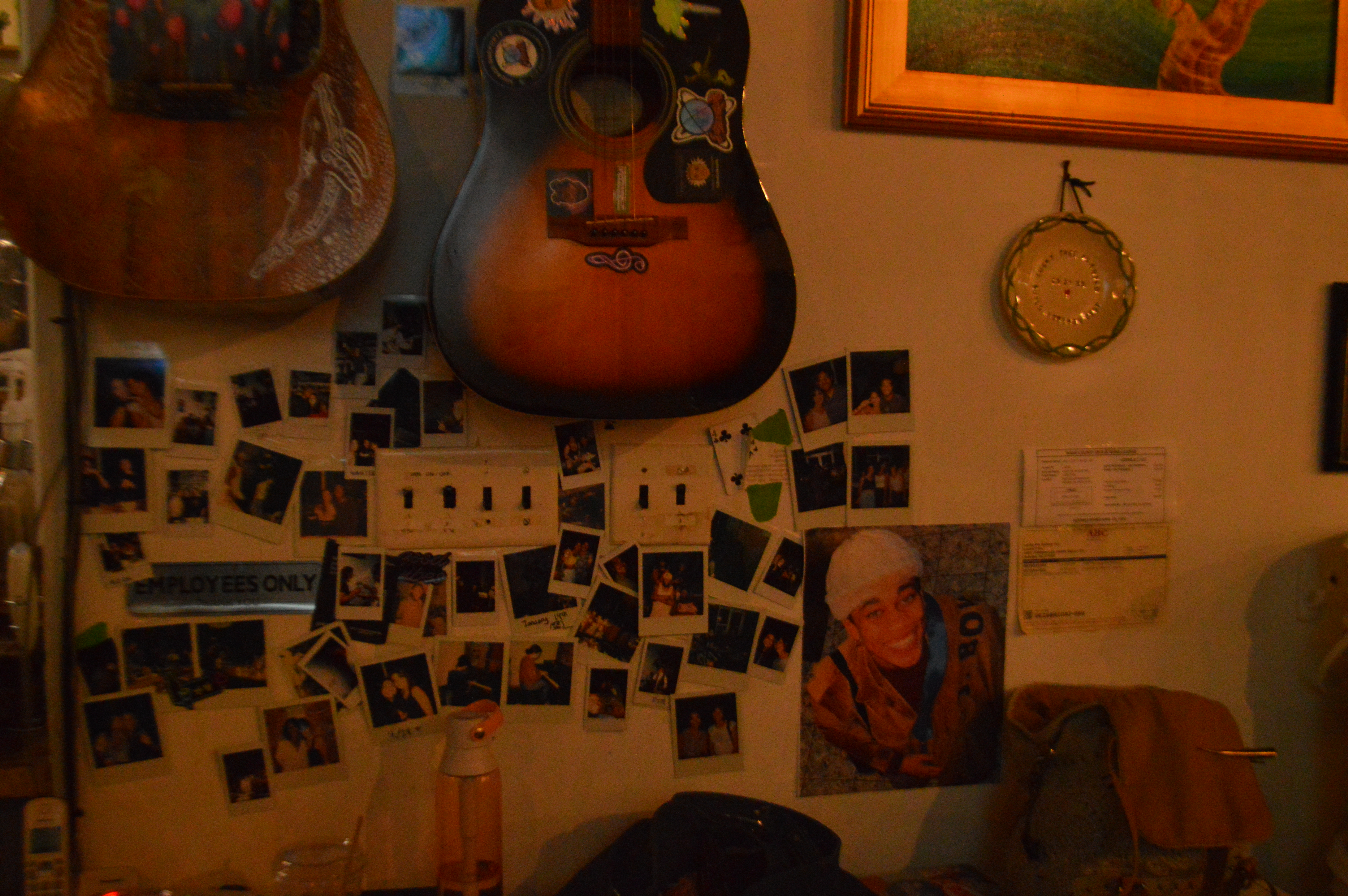
The room is filled with found objects, recycled pieces and things that had been headed toward the dump. Like the childhood treehouse, Lucky Tree wears its construction openly. Its surfaces do not match. The art does not stay obediently at eye level. Instruments, bodies, lights and cables overlap.
“A lot of things that have stories, a lot of recycled things that were headed to the dump,” Faries said.
Those histories keep the room from feeling decorative in the sterile sense. The objects were something before they arrived there. Some still show it.
“It doesn’t feel flat,” Faries said. “It feels warm.”
Warmth, here, is not polish. It is evidence of use.
The same is true of Live Mic. It started the first week Lucky Tree opened in Raleigh, with a few people sitting together in what Faries remembers as a “living-room style” gathering. Then more people came. They brought instruments, original songs, friends, nerves, grief and unfinished versions of themselves.
“The whole business itself has been an organic process,” Faries said. “It’s almost like an art form that’s still growing and has layers.”
More than a decade after Lucky Tree began, Faries does not speak about it as though the work has reached completion.
“It’s not done by no means,” she said. “We’re still creating it. We’re still in it.”
That may be why the room can hold so many kinds of arrival. It does not ask people to enter something pristine and leave it untouched. A first-time singer changes it. So does an audience member who keeps returning, a rapper who starts a circle outside or a musician who slips into the jam after the list ends.
Like the treehouse, Lucky Tree was built by a family.
Then other people gave it a life.
After years of Live Mic nights, Faries cannot choose a favorite.
Some evenings remain small enough to feel like the living-room gatherings where the event began. On others, bodies pack the cafe until, as Faries puts it, “the energy is insane.” Each night carries “its own kind of magic,” she said. She remembers collaborations, first performances and the moments when artists seem to surrender completely to what they are making.
But when she reaches for the memories held closest, one person appears.
J BOW.
“I can’t help but think of her,” Faries said.
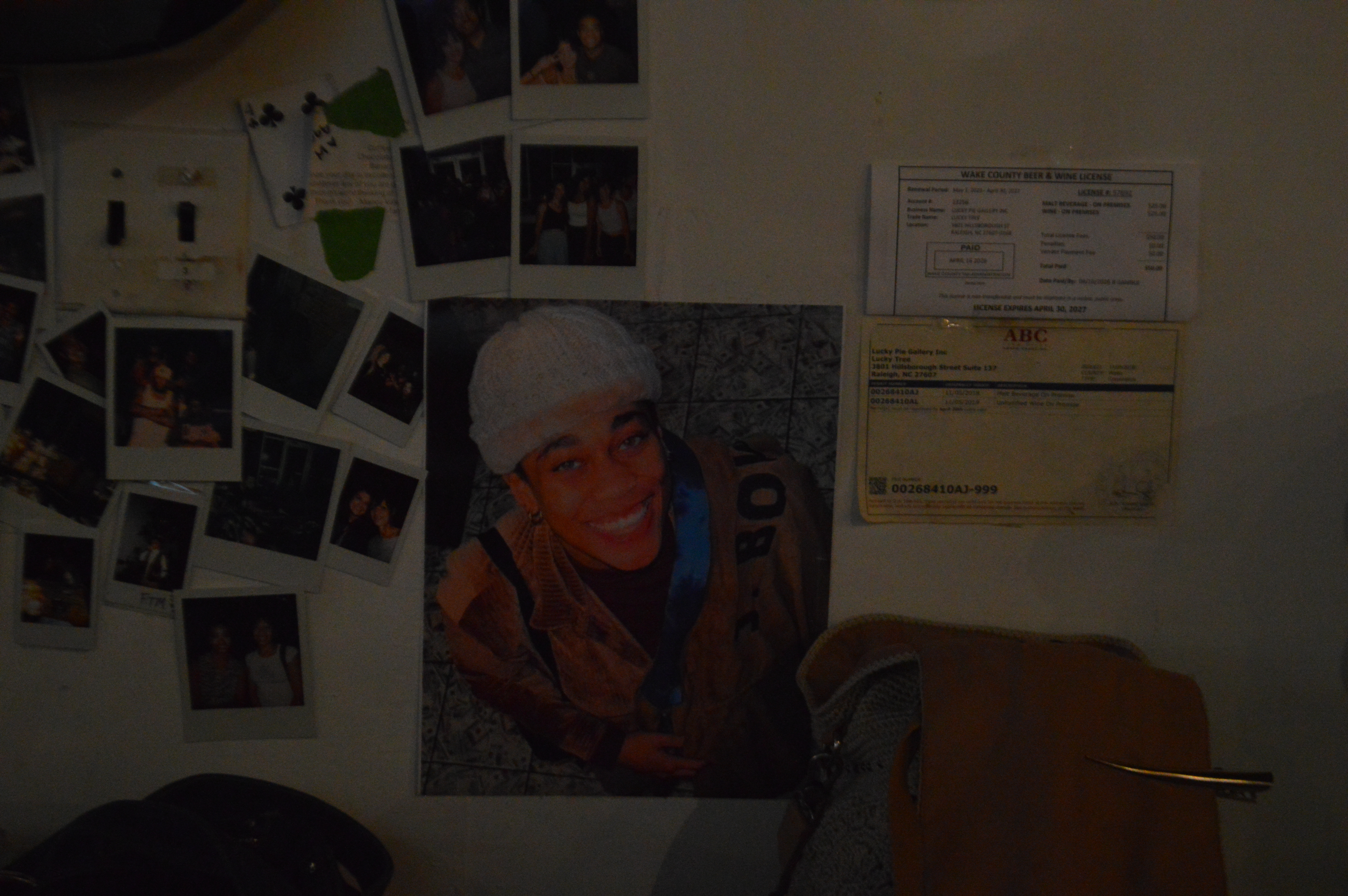
J Bow was not the first person to make Lucky Tree feel alive, and she would not be the last. Still, she altered the room in a way that has outlived her.
“She wasn’t the first, and she’s not the last,” Faries said. “But she was so incredibly special.”
J Bow, who has since died, also lives inside Deneil’s memory of his first night at Lucky Tree. He had entered alone in October 2022, knowing nobody. She was among the people he met before the room became familiar.
“Rest in peace,” Deneil said as he remembered her.
For Faries, the memory arrives closer to the surface.
“I want to cry when I think about her because I really miss her,” she said.
Then the words narrowed into repetition, as though one description could not hold what J Bow had been.
“What a gift. What a light. What a gift.”
Faries said J Bow inspired people wherever she went. Her absence reveals something else the cafe has gathered across more than a decade of Monday nights. People do not move through Live Mic as temporary names on a sign-up sheet. They return enough times to recognize one another. They exchange numbers. They form bands, friendships and memories that continue outside the cafe. They leave traces.
Some traces are easy to see: chalk ground into the pavement, artwork secured to the ceiling, a henna stain darkening on someone’s hand. Others surface only when a familiar name is spoken and a person pauses before continuing.
The room remembers both.
Deneil’s place within it has also changed. He no longer arrives without knowing anyone. He performs. He MCs. The community he once hoped to enter is now one he helps hold open for the next stranger.
“Some of my best friends I met here,” Deneil said.
Finding Lucky Tree, he said, became “the catalyst of great things.”
That same change may already be beginning for other people. Bryan has only started making connections there. Henderson can trace almost everyone she knows in Raleigh music back to the cafe. Gomez never steps behind the microphone, yet the room would still be smaller without people like her listening inside it.
No two people leave the same mark. Perhaps that is why Faries cannot reduce years of Live Mic to one perfect night.
The family created the space.
The people who keep returning give it a memory.
Eventually, every name is called.
The paper that organized the night has finished its work. Some people settle their tabs and leave. Conversations drift toward the doors. Outside, a loose circle may still be trading bars beneath the night sky, each rapper building on whatever the last voice left behind.
Inside, no one packs away the music.
Someone begins to play.
Another musician listens for the shape of the song, then enters. A voice rises over the progression. Percussion follows. Jackson stays beside the soundboard, striking the drum beneath him when the moment asks for it. There is no longer a sequence of individual performers waiting to be introduced. The stage has become less a destination than a center of gravity.
The final jam can stretch into the early morning.
For Henderson, it is the part of Live Mic she anticipates most. As the room thins, some of the evening’s ambition thins with it. The people who came to network have often gone. What remains is smaller, sweatier and less concerned with being seen.
“It’s literally just the music,” Henderson said. “It’s just the vibes.”
This is when she feels the room reach “that second plane that music only can reach.”
It is also when the boundary between audience and performer becomes hardest to defend. Someone who never made the list can sing. A musician can enter for a few measures and leave without having to claim the song. A listener can stand close enough to feel the bass move through the floor.
Nearly four years ago, that opening was waiting for Deneil.
His friends had canceled.
He had come alone.
The list was full.
Then the jam began.
He sang.
And he came back.
Now he stands at the microphone and makes room for someone else to do the same. It may be a singer who has followed Lucky Tree online for years, a musician searching for a way into Raleigh’s scene or a rapper carrying the rhythm in from the cypher outside. They do not have to know anyone yet. They do not even have to arrive on time.
The room was built to remain unfinished.
Outside, chalk still covers the pavement around the rusted drum kit. Voices gather beyond the cafe doors, trading verses after the formal performances have begun. Inside, artwork crowds the walls and watches from the ceiling. Cables cross the floor. Jackson’s seat is still a drum. The last name has been crossed from the list, but no one seems to mistake that for an ending.
Long after the list runs out, Lucky Tree is still making room. And someone is still playing.
 FILM / CULTURE / BLACK HAIR
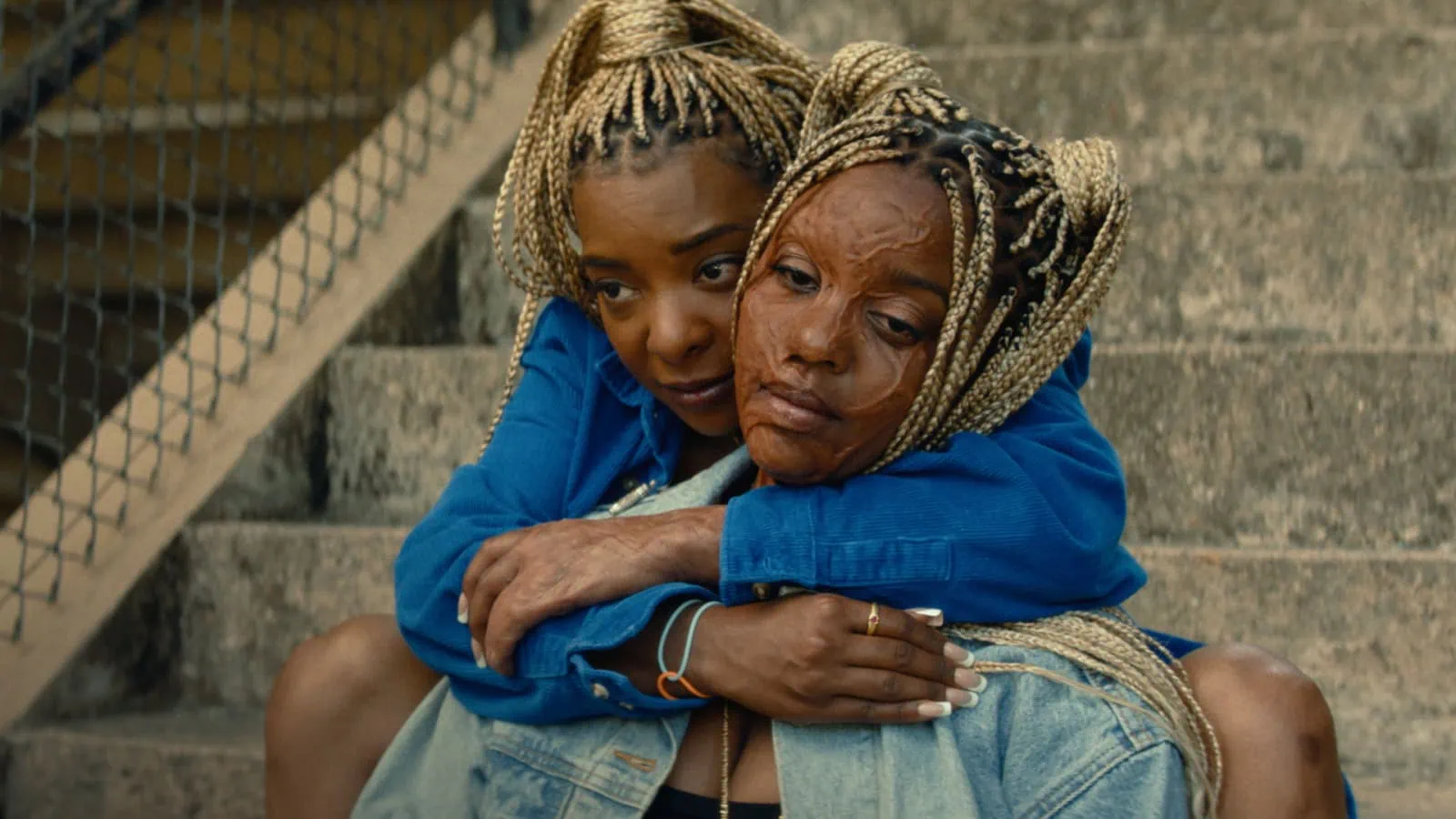
In Is God Is, Racine and Anaia's matching blond braids first make the sisters look almost inseparable. Look closer, though, and the illusion begins to loosen.
HAIR // INHERITANCE // IDENTITY
The twins' matching braids ask us to see sameness. The roots tell a more complicated story.
At first, there is almost nothing to separate Racine and Anaia.
Their blond braids fall in the same long, pale ropes, framing them like two versions of the same image. They move together, dress in complementary clothes and occupy space with the familiarity of people who have spent so much of their lives side by side that even silence can become a language. Their sameness feels deliberate. Before the film begins pulling them apart, it teaches us to look at them as a pair.
The hair helps complete that illusion.
From a distance, the braids seem nearly identical. Look closer, though, and the illusion begins to loosen.
Racine's natural hair is tucked almost entirely inside the blond extensions, creating a smoother wash of color from root to end. Almost entirely. Here and there, tiny pieces of black peek through, so quietly that they can disappear into the braid unless you are already looking for them.
Anaia's natural hair is harder to miss. The black pushes through the blond more visibly, disrupting the pale strands instead of disappearing neatly inside them.
The difference is slight.
But Is God Is is a film that asks us to pay attention to what survives beneath a surface.
The twins' braids begin to feel almost like another version of their scars: something they share, something produced by the same history, yet something that refuses to sit exactly the same way on two different bodies.
Hair already carries a certain intimacy throughout the film. The sisters' lives are bound together through the small rituals of existing beside another person, while their mother, Ruby, is surrounded by women tending to her hair as she lies dying.
Braiding becomes more than decoration in these moments. It becomes touch. Care. Womanhood passed from one set of hands to another. There is something almost ceremonial about it, as though hair can hold history long after the body has grown tired of carrying it.
The twins' matching braids place them inside that same visual lineage. Their hair links them before they fully understand everything else that has been passed down to them.
And inheritance in Is God Is is rarely gentle.
Racine speaks about violence as though it lives somewhere inside the body, carried through blood before either sister has the chance to decide whether she wants it. Their father nearly killed their mother. Their mother survives long enough to send her daughters back toward him with another act of violence waiting at the end.
What begins as revenge slowly becomes something more unsettling: a question of what children inherit from the people who made them and whether knowing where something came from is enough to stop yourself from becoming it.
The braids quietly hold that same question.
You can cover it. Wrap something around it. Change the shape that other people see. You cannot make the root disappear.
That distinction becomes even sharper when placed beside the sisters' scars. Racine survived the same fire as Anaia, but much of her scarring can be hidden beneath clothing.
Anaia does not have that distance from what happened to her. Her scars stretch across her face, neck and body, forcing the past into every first impression. Before she explains herself, before anyone knows her name, her body has already told them that something happened.
Racine gets to decide more often when that story becomes visible.
And Racine has built herself around that kind of control. She is sharper where Anaia is softer, more willing to turn fear outward, more willing to meet violence with violence. Her anger often arrives before anything more vulnerable has the opportunity to surface.
There is a kind of armor in her, not because she feels less, but because feeling has been compressed into something harder.
Her braids do something similar.
The black at Racine's roots is not gone. It whispers.
A strand appears and disappears beneath the blond, evidence of something underneath that the surface cannot entirely swallow. The detail almost becomes more powerful because it is so subtle. Racine is not a woman without wounds. She is a woman whose wounds have learned how to speak quietly.
Anaia's do not.
Her scars make secrecy impossible, and her hair echoes that exposure. The black beneath her blond braids comes through more clearly, refusing the smoothness Racine's style nearly achieves. What lies underneath Anaia is always closer to the surface.
It breaks through.
That idea of an "underneath" follows the sisters far beyond their hair. At one point, Racine asks Anaia whether she has ever wanted to scrape away her scars simply to see what is beneath them.
It is a brutal question, but it also feels like one of the film's central questions.
What is underneath the scar?
What is underneath the anger?
What is underneath the daughter carrying out her mother's vengeance?
What is underneath "the twins," once the two women inside that word begin pulling in different directions?
Their hair gives the film another way of asking.
The blond extensions do not have to represent something false, and the natural hair underneath does not have to stand for some purer, more authentic version of either sister. That reading would flatten something much more interesting.
Blond box braids are still unmistakably part of Black hairstyling, shaped through a tradition in which hair can be protective, expressive, communal and transformative all at once.
What matters here is not artificial versus natural. It is surface versus what the surface cannot completely contain.
The extensions reshape what we see first, but the hair beneath them remains attached at the root. Trauma behaves in much the same way.
Racine can turn hers into rage. Anaia can carry hers through hesitation and tenderness. They can dress alike, braid their hair alike and walk toward the same destination.
There is something almost defiant, too, in how visible the hairstyle itself is. Their braids are not quiet. They are long, bright and conspicuous, spilling down their bodies in a blond that catches against their skin and the film's harsh landscapes.
The same hairstyle that contains an act of covering at the root becomes impossible to ignore as a whole.
That contradiction feels fitting for two women who spend so much of the film both hiding and being seen.
Anaia is seen before she can choose to be. Her scars make sure of that.
Racine appears more capable of controlling the terms of her visibility, but even she cannot seal herself completely. The dark strands still find their way through the blond. The pain still finds its opening.
That is what makes the tiny flashes of black in Racine's hair matter. If her braids were completely blond while Anaia's natural hair remained exposed, the visual metaphor would almost become too neat: one sister hides while the other reveals.
The difference between the sisters, then, is not that Anaia has something underneath while Racine does not. They both do.
The difference is how loudly it speaks. Racine's roots whisper beneath the blond.
Anaia's break through it.
They came from the same mother. They survived the same father. The same fire reached both of their bodies, yet it did not write itself across them in the same language. One sister can cover more of the sentence. The other carries it openly across her skin.
At first glance, their hair asks us to see sameness.
Then the eye adjusts.
Black begins to appear between the strands.
The closer you look, the less perfect the mirror becomes.
And maybe that is the point. Racine and Anaia can share blood, memory, grief and even the same braids without becoming interchangeable. The film spends so much time placing them beside one another only to reveal all the quiet places where one sister ends and the other begins.
Their braids match because they share a history.
Their roots interrupt that symmetry because they do not share a self.
Racine's almost disappear beneath what she has wrapped around them, though they never vanish completely. Anaia's remain nearer the surface, darker strands breaking through pale blond as persistently as everything else her body has been forced to remember.
The fire touched them both. It simply could not burn them into the same shape.
 DURHAM, N.C. / CREATIVE REUSE
For Bee Mangine, discarded cans, old neckties, retired Kevlar and family scraps are not endings. They are material waiting for another life.
FASHION // CREATIVE REUSE // INHERITANCE
Bee Mangine builds garments from what other people leave behind, letting cans, ties, Kevlar and family history keep their old lives visible inside the new ones.
The aluminum refused to cooperate.
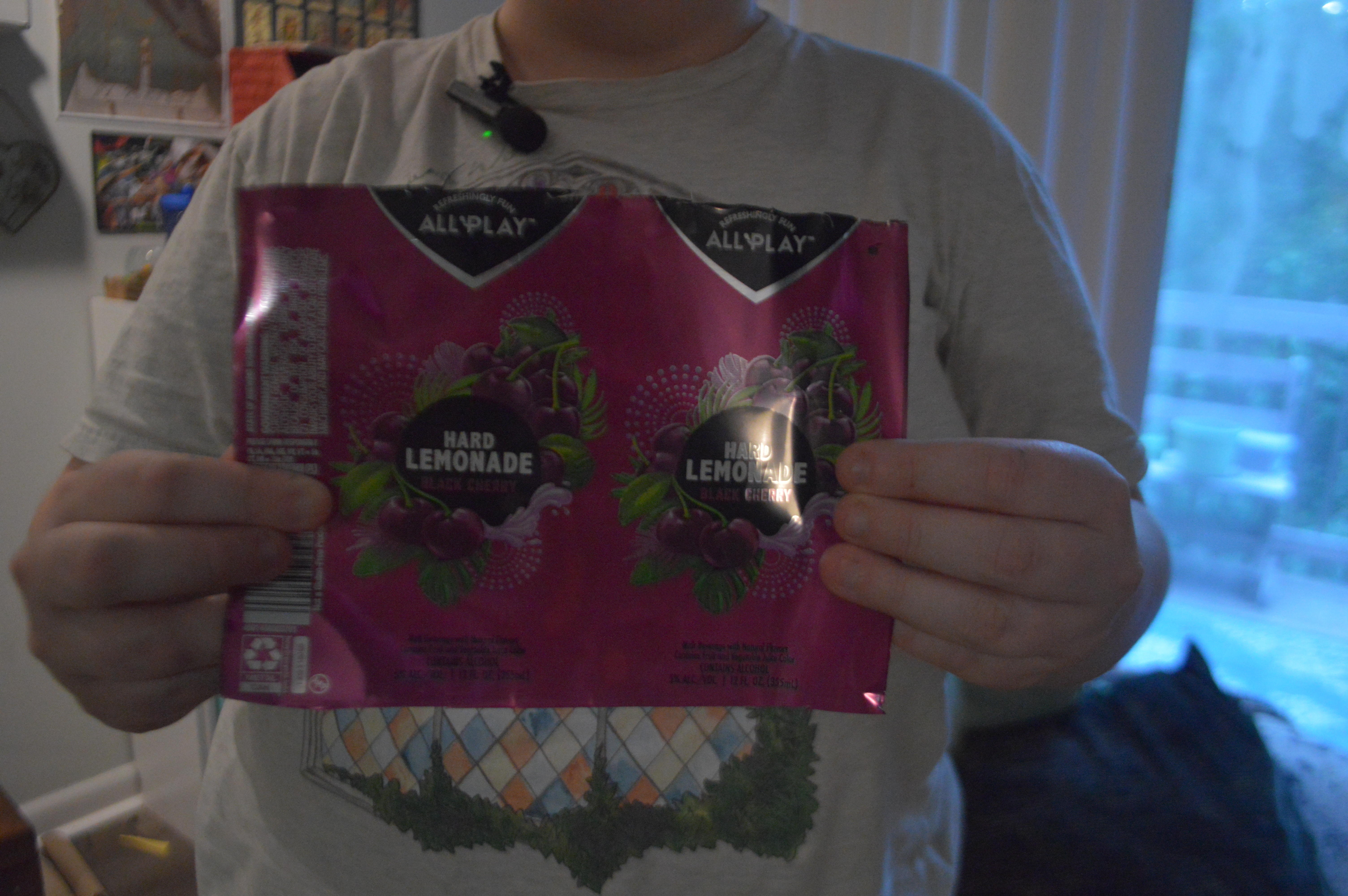
It had already spent one life wrapped around hard lemonade, stacked among the cans Bee Mangine and their partner saved after friends came over. They rinsed the cans and meant to recycle them, but the trip never happened, so the pile kept growing until Mangine decided to cut into it.
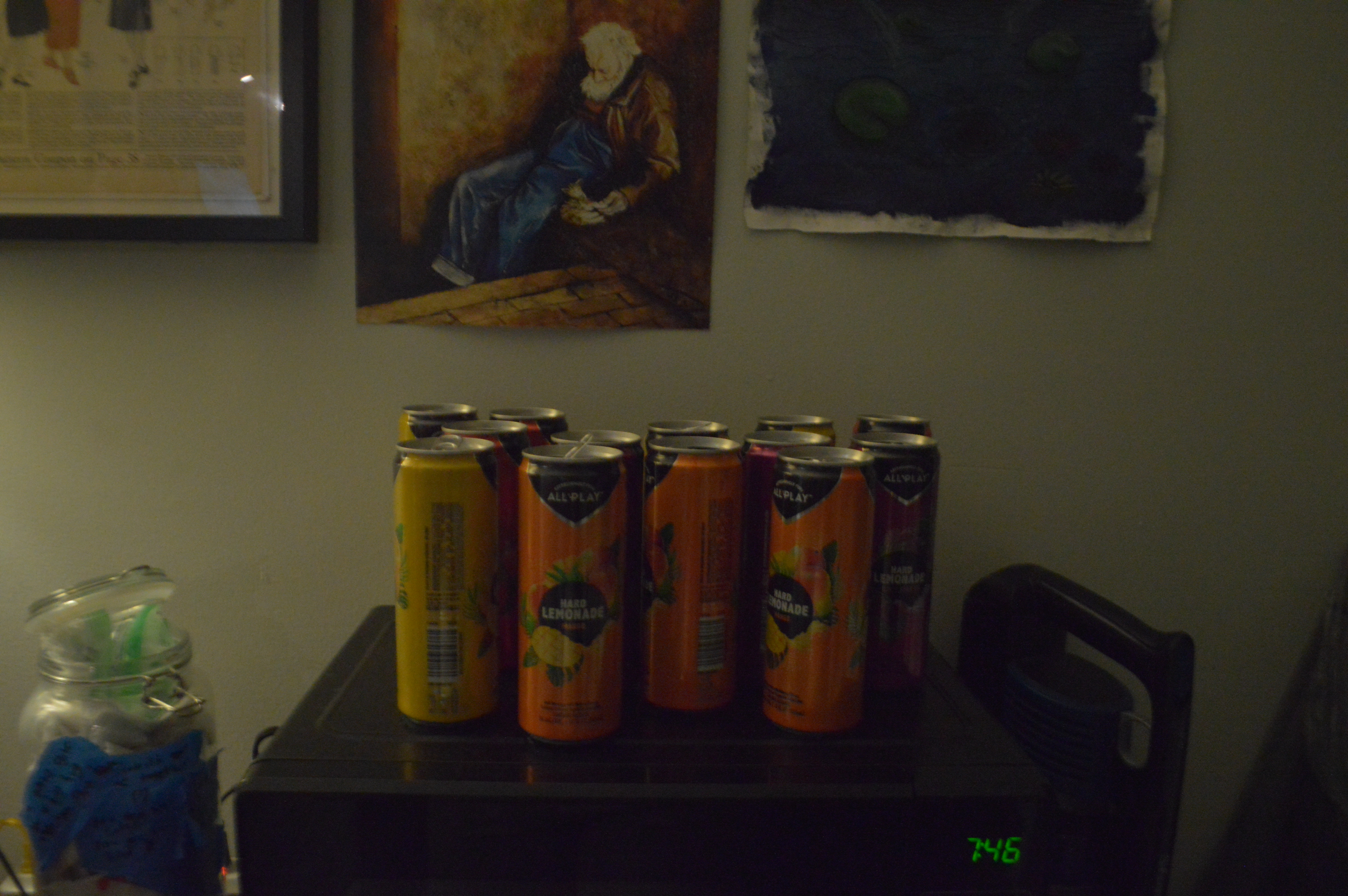
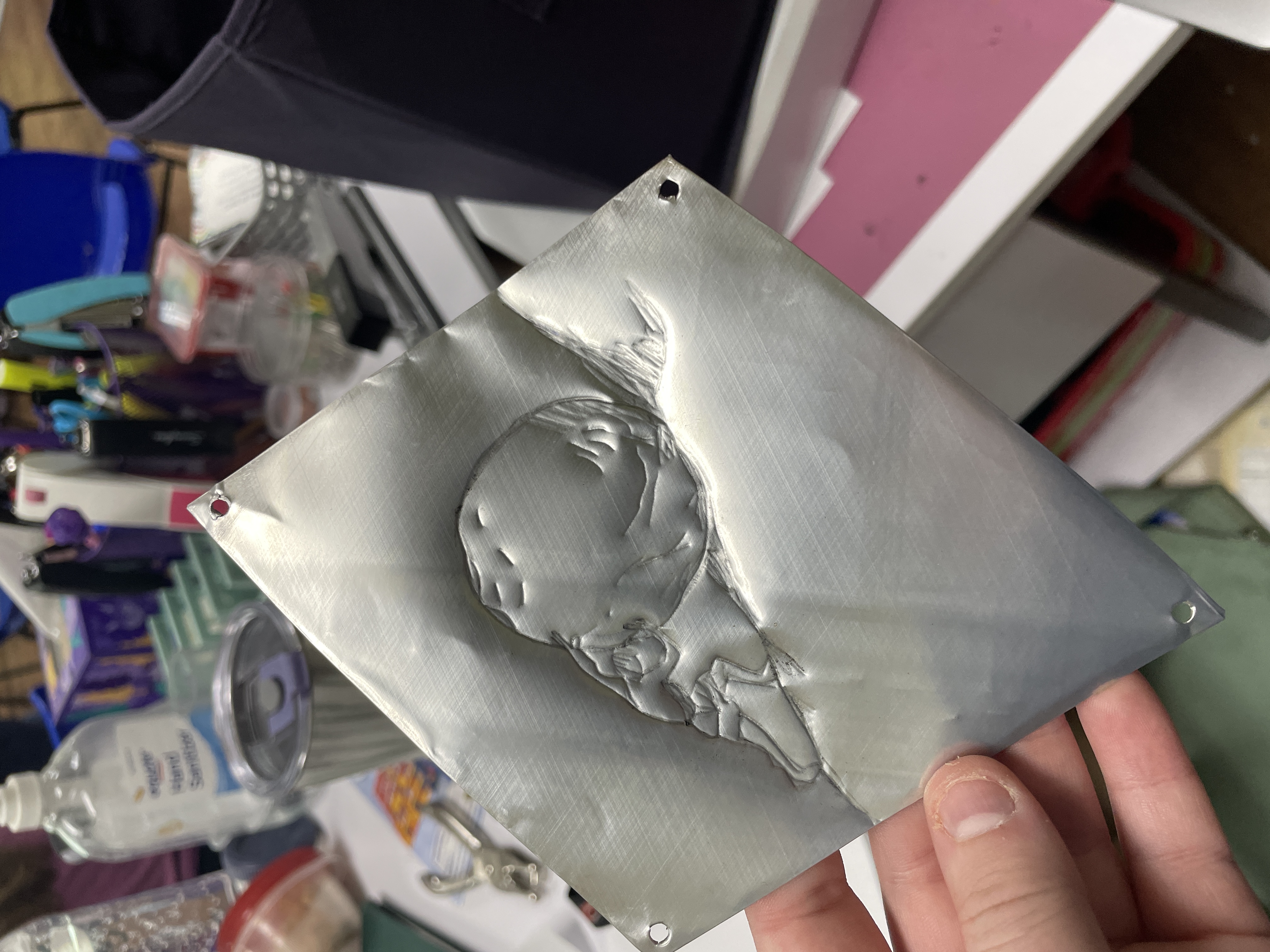
They sliced the aluminum into diamonds, each about 5½ inches wide and 7 inches from point to point. Even separated from the cans, the metal held onto its factory-made curve, folding stubbornly inward as though it remembered the shape it had been given.
Mangine tried pressing the pieces flat with an iron, then weighed them down beneath a heavy book. Neither worked. They eventually left the iron on the metal for nearly 10 minutes before the possibility of ruining the ironing board, or starting a fire, became more urgent than flattening the aluminum.
“We don’t want fires,” I said when Mangine recounted the experiment.
Eventually, they found an artist online with another suggestion: use the oven. Mangine spread the pieces across a baking sheet, pressed them flat by hand, weighed them down and baked them at about 450 degrees for 45 minutes. Then they turned off the oven and left the aluminum inside for the rest of the afternoon, waiting for the heat to fade.
This time, the metal gave in.
“That worked like a charm,” Mangine said. “So I stay winning.”
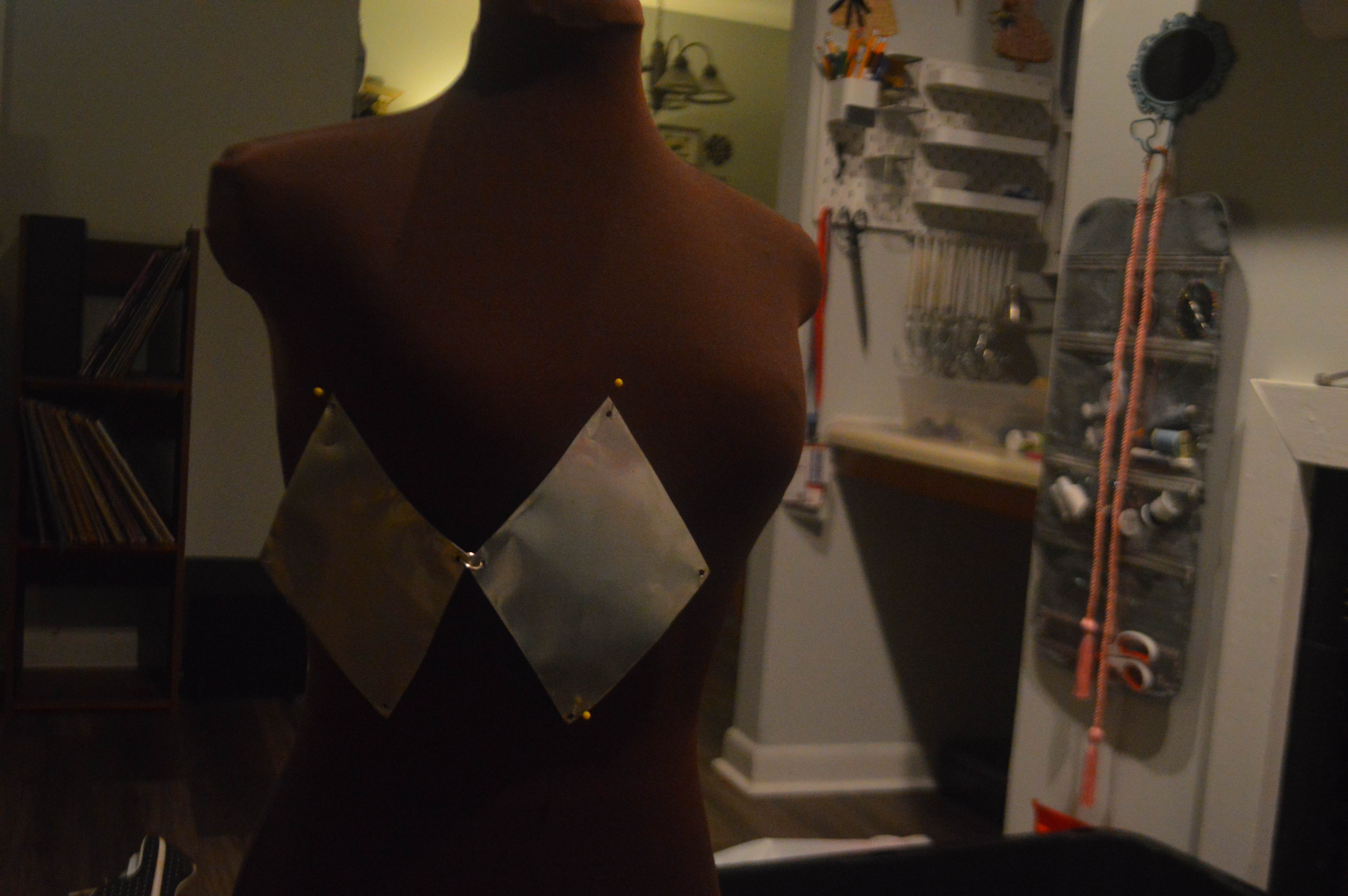
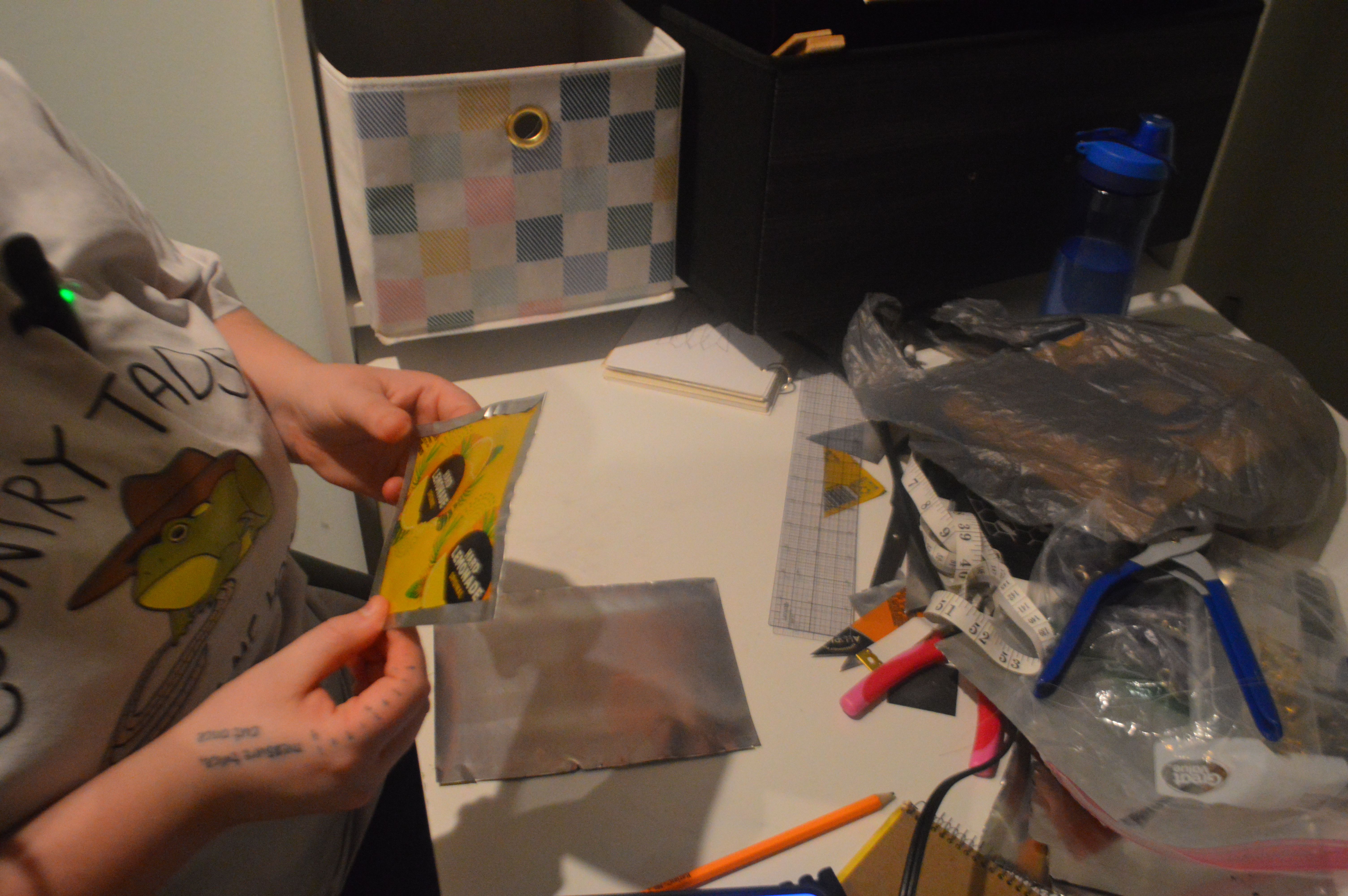
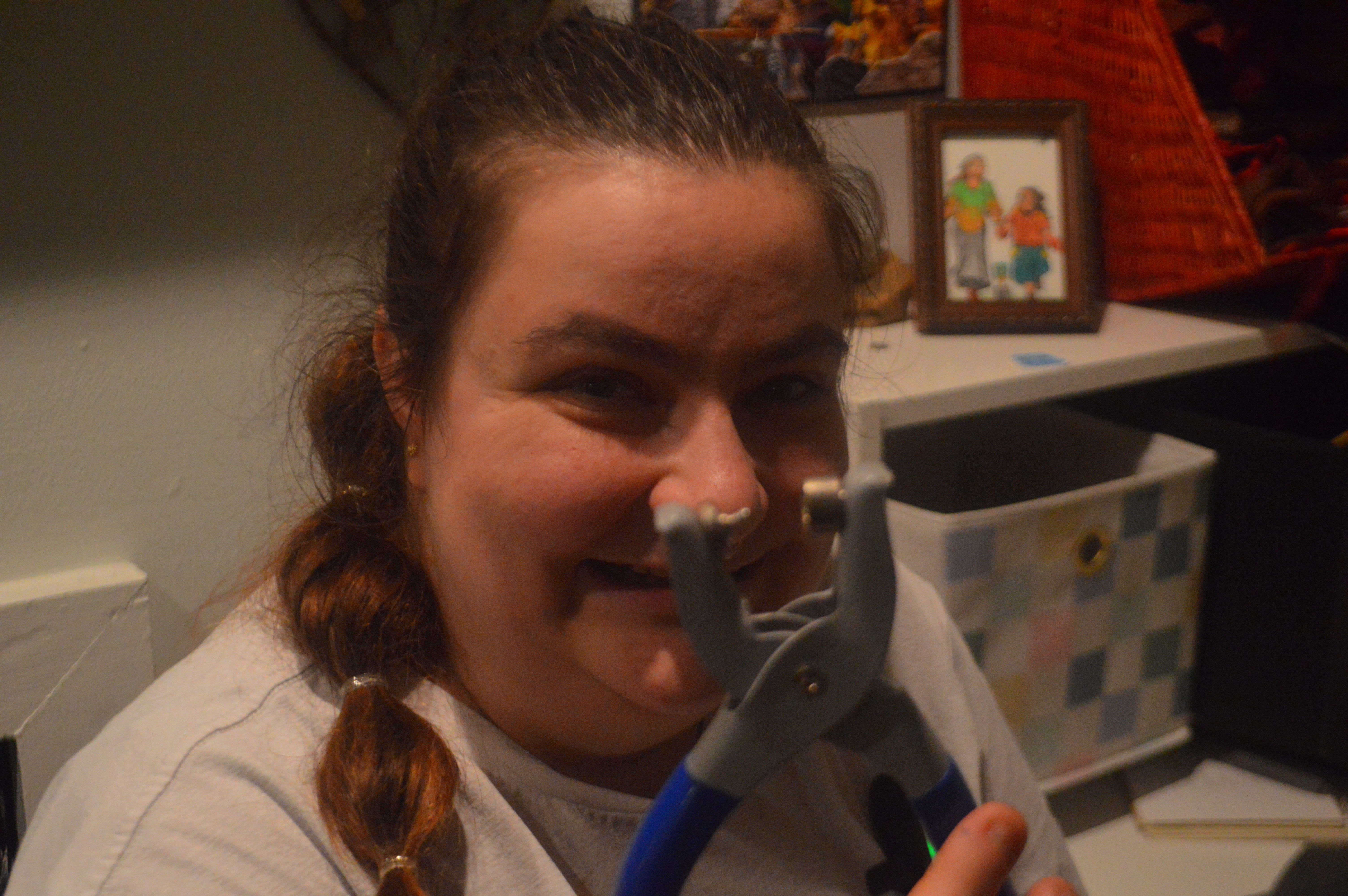
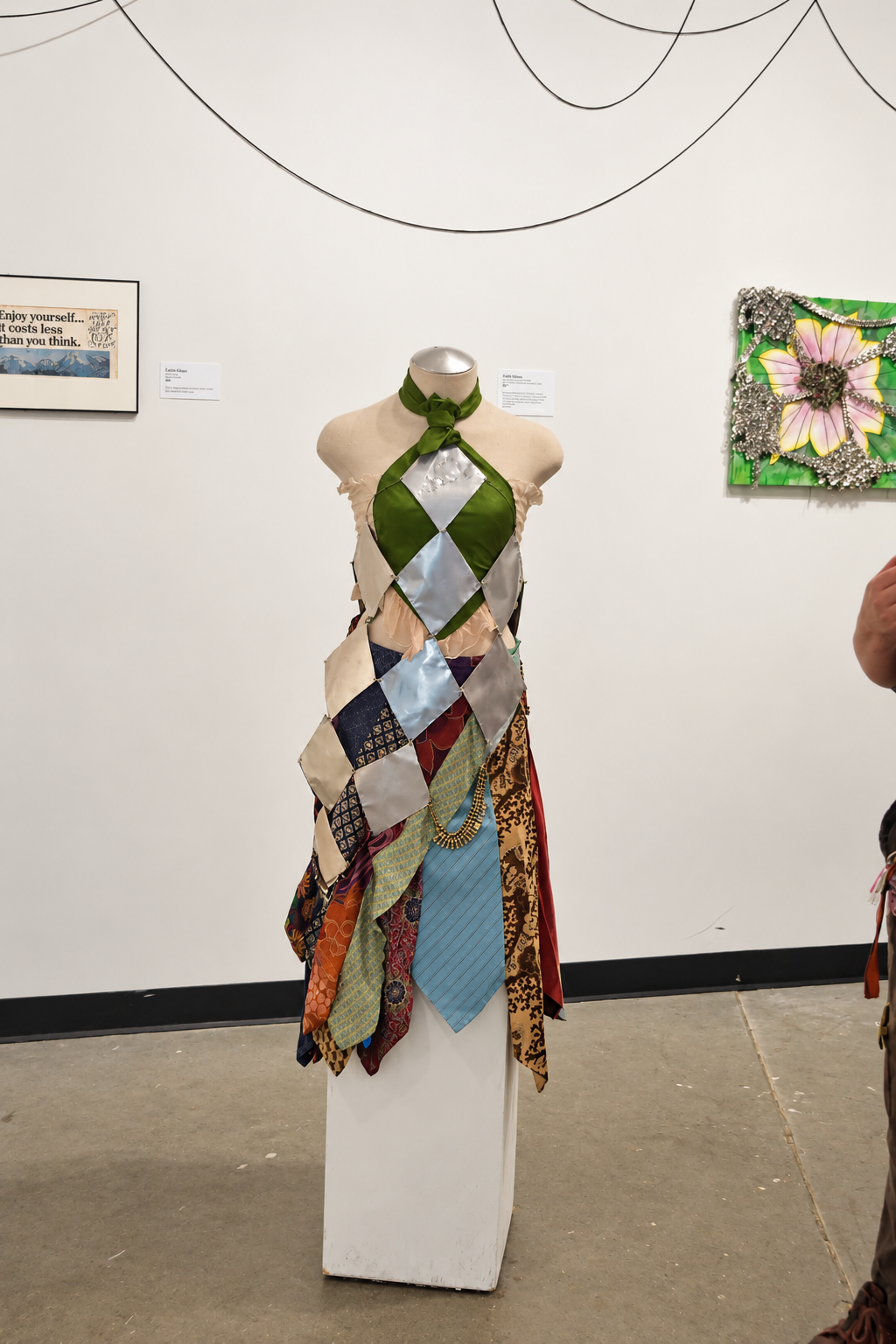
From there, the cans began to lose their old shape one by one. Mangine traced a template across the flattened aluminum and punched holes around each diamond with a tool normally used to attach snaps to clothing. Small jump rings linked the pieces together, allowing the rigid scraps to move as a unit and giving the top an armor-like quality.
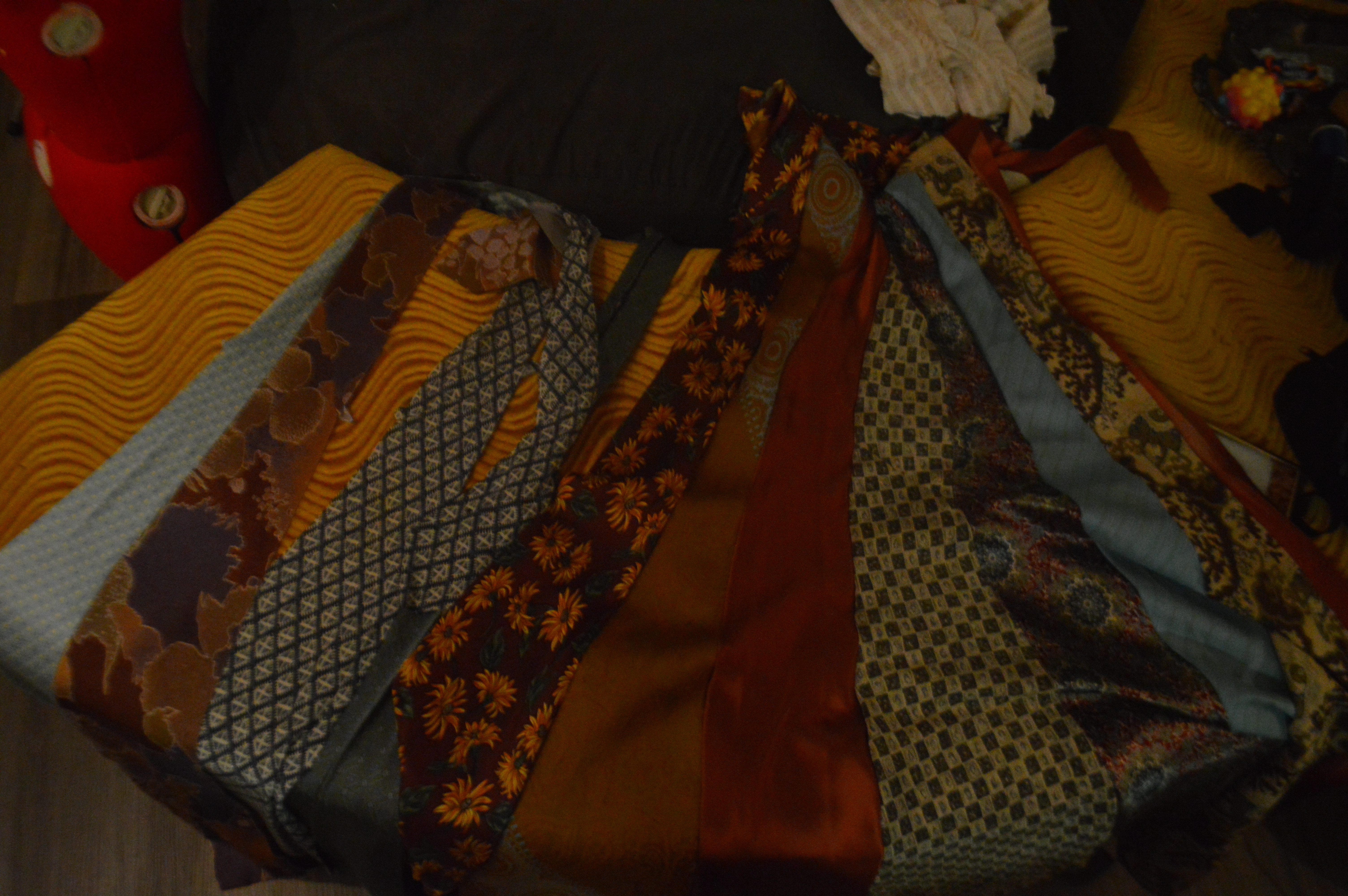
The rest of the garment followed the same logic: use what is already there. Old neckties Mangine had hoarded because they were pretty became a low-waisted skirt and part of a halter-style top. Stretchy fabric sitting around the house became its base. Later, when the top looked disconnected, Mangine dismantled a thrifted necklace and reused its chain.
Almost nothing in the garment ended where it began.
But Mangine wanted the aluminum to carry more than the remnants of a drink label. While the piece was still unfinished, they began thinking about a story they could press into the metal, something simple enough to emboss but meaningful enough to belong there.
They landed on Sisyphus.
In Greek mythology, Sisyphus is condemned to push a boulder uphill forever, only to watch it roll back down before beginning again. Mangine recognized something familiar in that repetition.
“I can keep all this shit out of the landfill,” they said, “but there’s just more in there.”
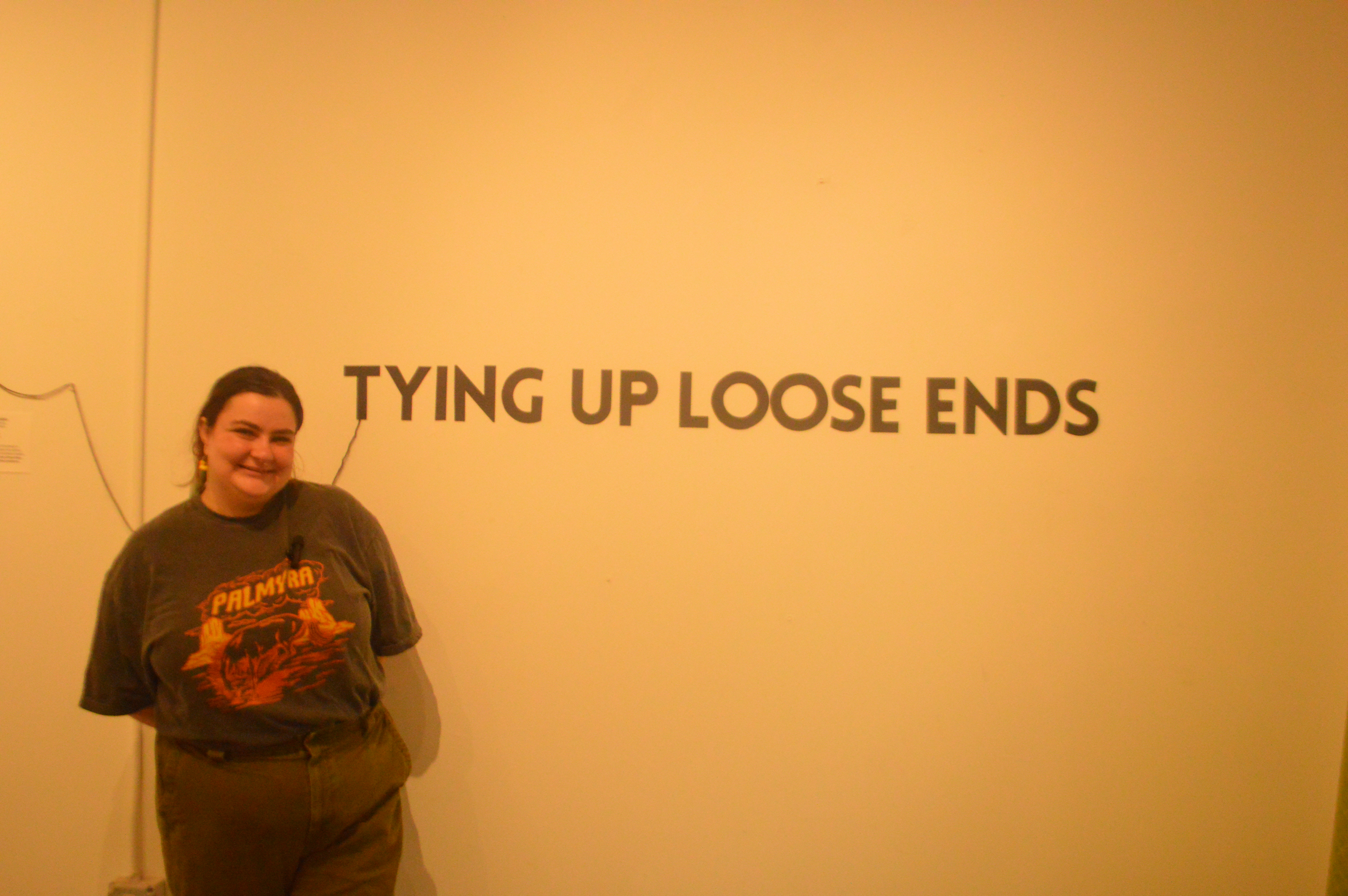
At first, they were not sure Sisyphus would make the final piece because the idea felt almost too cynical. By the time the garment reached The Scrap Exchange gallery in Durham, though, there he was. Mangine called the finished work Feels Like a Sisphyian Task, made from upcycled ties, jewelry and aluminum cans.
Mangine designed the figure on an iPad, printed it to size, rubbed graphite onto the back of the paper and traced the image onto one of the aluminum diamonds before darkening portions by hand. On the finished piece, Sisyphus bends into the metal, his body pressed forward behind a boulder that will never stay where he puts it.
Around him, nearly everything has already escaped one ending. A can has become armor. Neckties hang from the waist instead of a collar. The chain of a thrifted necklace holds together something it was never made to touch.
The trash had been given another life.
For Mangine, reuse did not begin as an environmental philosophy. It began as ordinary life.
Mangine moved with their family to Jacmel, Haiti, shortly before turning 6. Because they were homeschooled, they were mostly removed from the daily pressure of dressing like other children their age, and Mangine remembers their childhood style as “funky and very me.”
Clothing came from different places. Some pieces were tailored and built to last, while others were secondhand imports. Mangine also remembers wearing pillowcase dresses sent as humanitarian aid, then belting them, adding purses and making them feel less like something assigned to them and more like something they could shape themselves.
That freedom existed alongside necessity. When Mangine’s family returned to North Carolina in 2015, money was tight, and thrift stores became a routine place to shop. Their mother had a rule for those trips — choose “something you want, something you need, something to wear, and something to read.”
At the time, Mangine did not think of thrifting as fashionable or politically conscious. It was simply how their family shopped.
As Mangine got older, finding clothes became more complicated. By around 12 or 13, the secondhand pieces they found did not always fit their changing body, so they began altering the clothes instead.
Their grandmother had already taught them to sew, and the skill belonged to family life before it ever entered a classroom. She gave Mangine small projects and once helped them make matching clothes for themself and an American-Girl-style doll. In childhood photographs, Bee stands beside dolls dressed almost like extensions of themself — an early version of something that would eventually become far more serious.
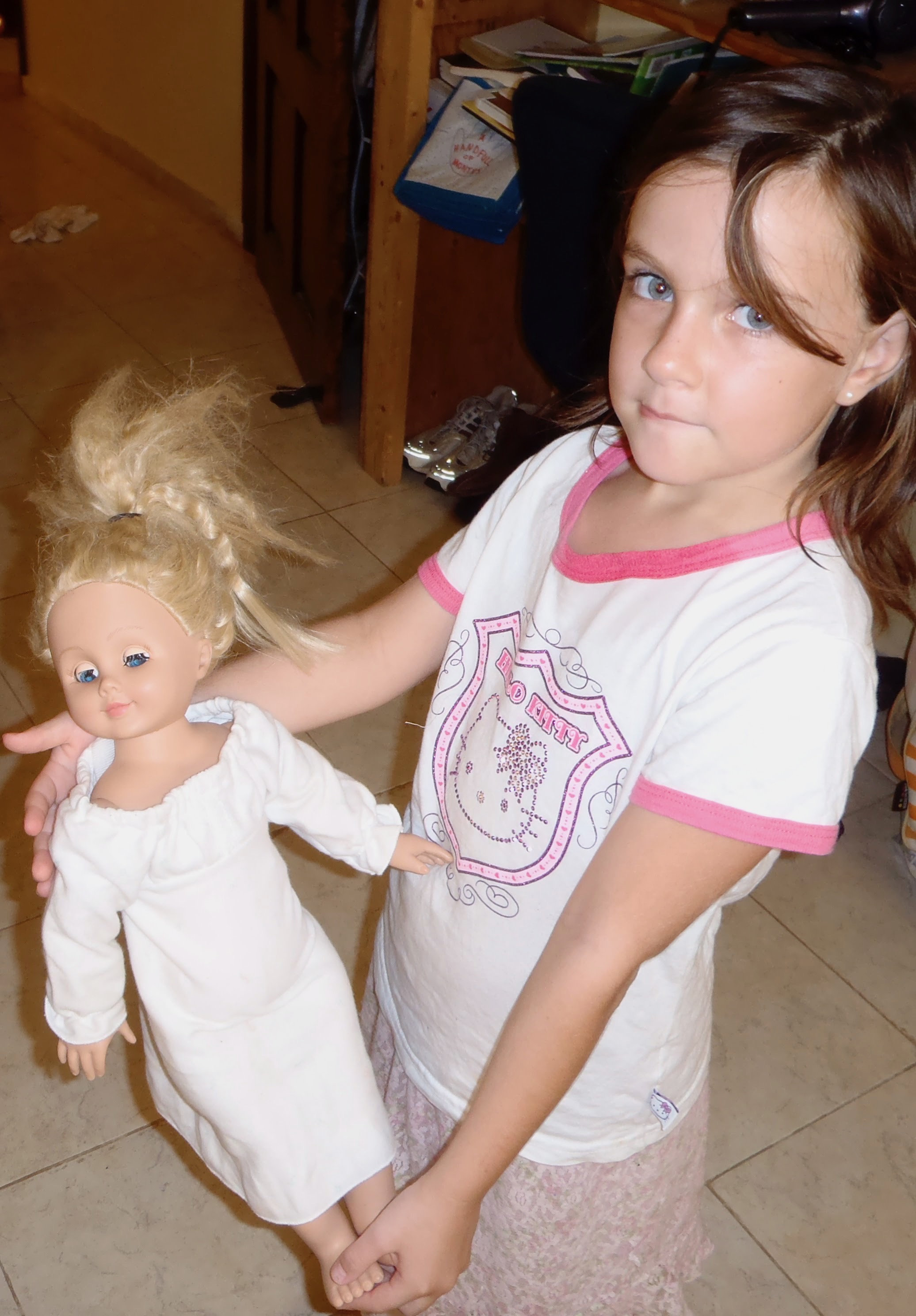
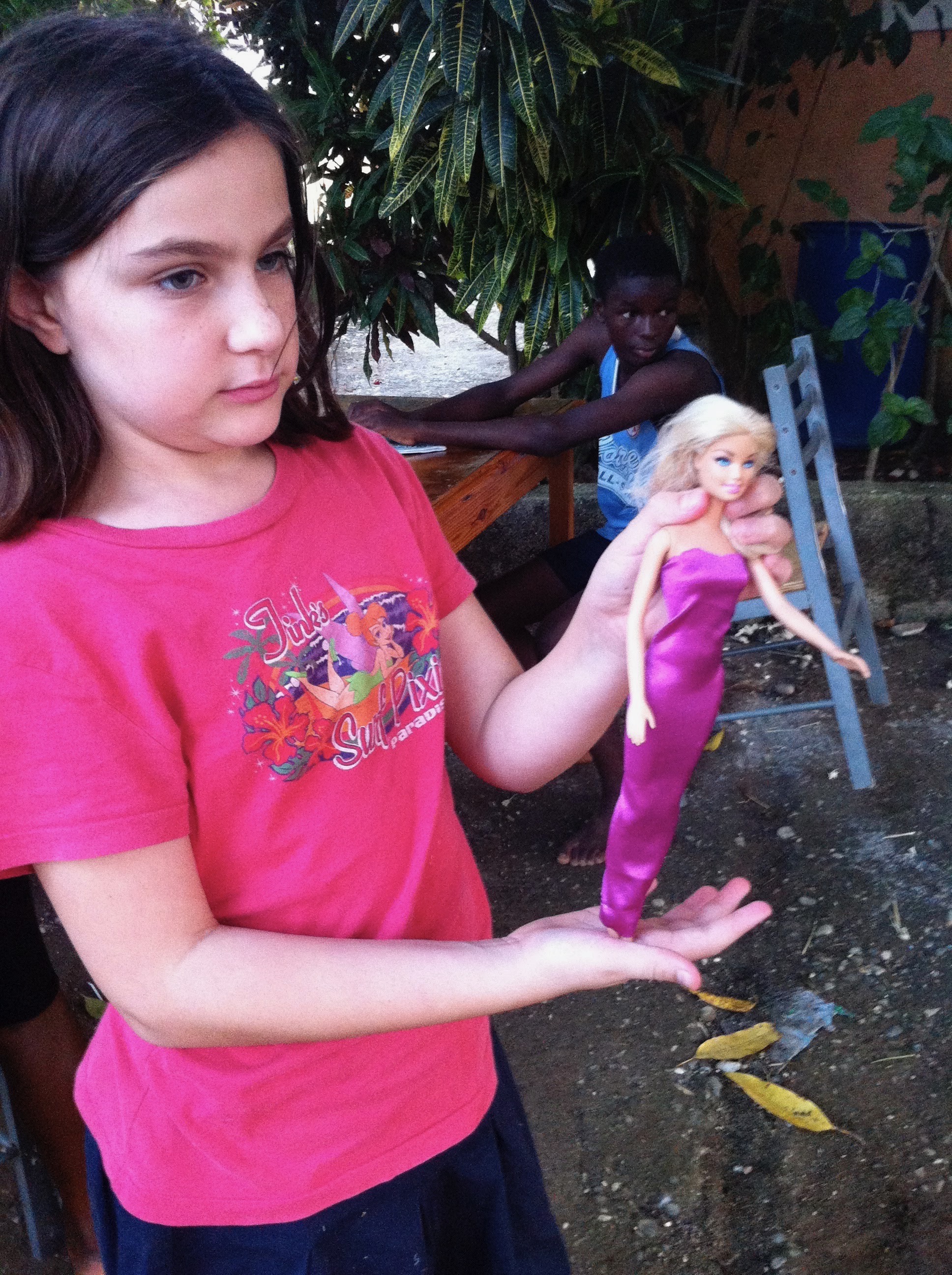
BEFORE FASHION SCHOOL, CLOTHING WAS ALREADY SOMETHING TO MAKE, ALTER AND SHARE WITH A DOLL. / FAMILY ARCHIVE
Later came apparel classes at Panther Creek High School, followed eventually by fashion school.
But the economics of sewing had changed by the time Mangine inherited the craft. For their grandmother, making clothing at home could be cheaper than buying it. For Mangine, the opposite is often true. On one birthday, they decided to treat themself to new fabric for a project, and the bill came to around $70.
A finished garment from a fast-fashion retailer can cost less.
“We don’t need this much clothing on the earth,” Mangine said. “There’s so much clothing, and all of it’s in the fucking landfill.”
Fabric is expensive, finished clothing can be startlingly cheap, and there is already more of it than people know what to do with.
So Mangine rarely begins by walking into a fabric store. They start with what already exists — a tie nobody wears, fabric left over from another project, a retired vest, a can waiting by the recycling — and let the material influence what comes next.
Traditional design can begin with a sketch and then search for the perfect material to fulfill it. Mangine often reverses the order. Sometimes the material interrupts the plan. Sometimes it becomes the plan entirely.
When Mangine arrived at NC State in fall 2021, sewing was no longer only the skill that helped thrifted clothes fit. It was becoming a profession.
At the Wilson College of Textiles, Mangine studied fashion design in a Bachelor of Science program, where chemistry and physics sat beside patternmaking and garment construction. At first, some of that science felt distant from the clothes themselves. Later, when Mangine began working with materials that were never supposed to become garments, the knowledge became unexpectedly practical.
Knowing how fibers burn can help identify an unknown textile. Understanding heat matters when a material reacts unpredictably under an iron. Water, pressure and fiber composition all become relevant when the designer cannot rely on a label to explain how something should behave.
A bolt of fabric arrives with expectations. Scrap often does not.
Mangine may know how cotton will respond to a needle, but aluminum requires negotiation, Kevlar brings a different set of rules and a thrifted textile may have no tag at all. Fashion school gave Mangine ways to investigate those materials, but it also gave them reasons to question the industry surrounding them.
That tension sharpened during their junior year.
In one pattern-drafting course, students worked from their own measurements. Mangine had roughly a 14-inch difference between their bust and waist, and the standard drafting instructions did not accommodate that difference well.
Years earlier, thrifted clothing had already taught Mangine that a garment could fit one part of a body and refuse another. Now the same problem was reappearing inside a classroom meant to teach them how clothes were made.
Mangine said the experience left them feeling as though fashion was not designed for people with bodies like theirs. They also felt unsupported by the instructor when the pattern failed to work, and for a time, they began questioning whether they wanted to work in fashion at all.
Other professors complicated that conclusion. Mangine found instructors who gave students room to experiment while still holding them accountable for the techniques a course was meant to teach. There was space, they discovered, to learn how something was supposed to be done without deciding it was the only way to do it.
Still, the larger industry began to feel less like a destination.
Mangine looked ahead at the jobs they might take after graduation and saw an emphasis on profitability, cost-effectiveness and repeatability — how to make more, faster and for less. Their own process moved in another direction.
They like slow work and one-off pieces. They like walking into a thrift store without knowing what they will leave with. If there are six good ties, the garment gets six good ties. If there is only enough strange fabric for one piece, then there will only be one.
What mass production treats as a limitation can become part of the design.
Mangine eventually decided they did not want a traditional fashion-industry career, but they did not abandon what school taught them. They kept the science, the patternmaking and the construction techniques, using each on their own terms.
“The way that I do stuff is not the way you should,” Mangine said while working on the newest garment.
Traditional fashion construction prizes precision — neat seams, controlled materials and meticulous finishes. Scrap is less obedient.
“To me, the recycled materials are more important,” Mangine said.
Fashion school taught Mangine the rules. Their work afterward gave them room to bend them.
The Scrap Exchange offered Mangine a different kind of runway.
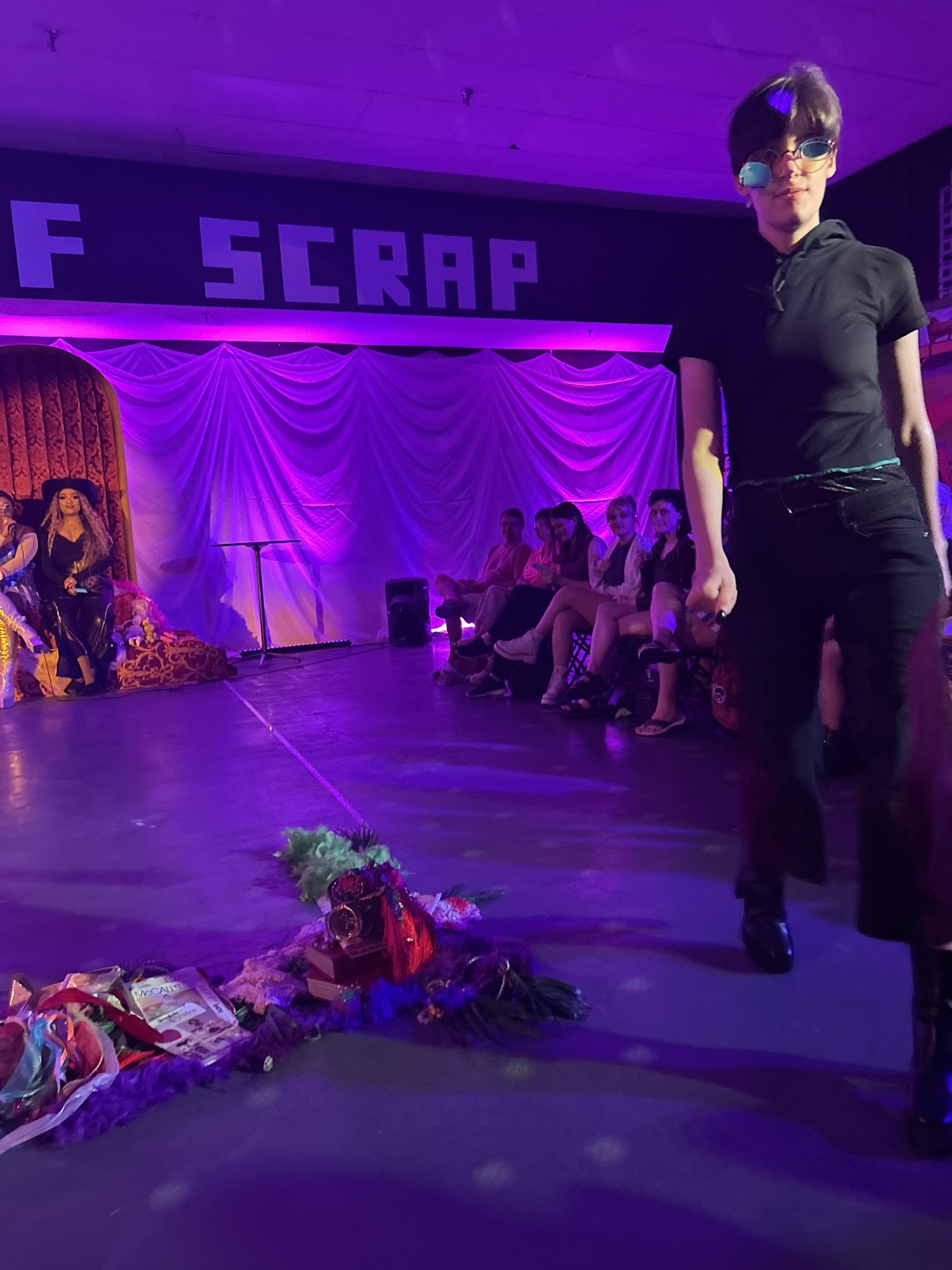
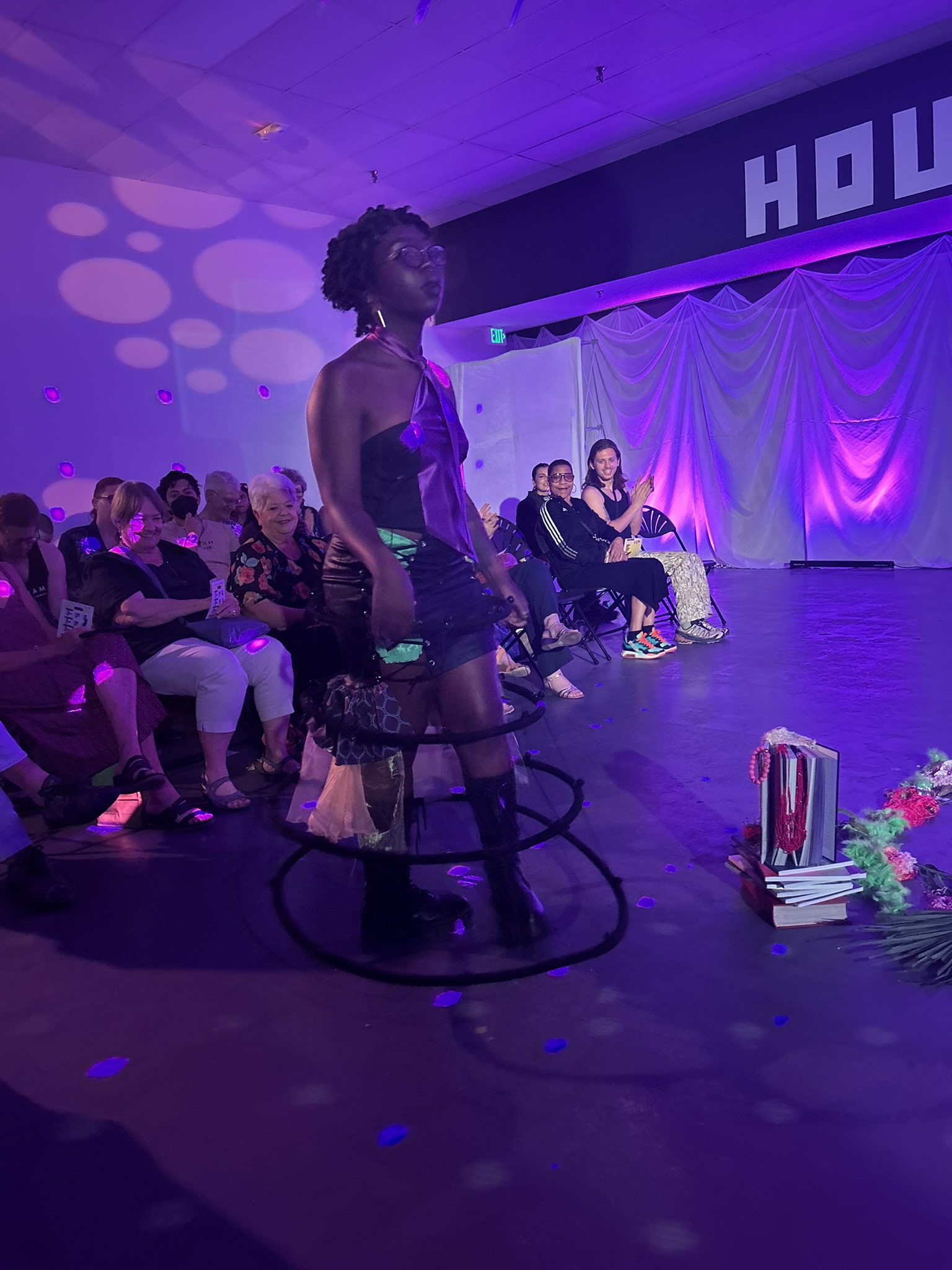
In spring 2025, the Durham reuse center held House of Scrap, a competition asking designers to create three looks from the materials people usually leave behind. The categories were doll-core, upcycling and trashion.
Mangine built a world around all three.
The resulting collection, “Reboot,” drew from science fiction and mecha anime, imagining characters pieced together in a future already transformed by waste.
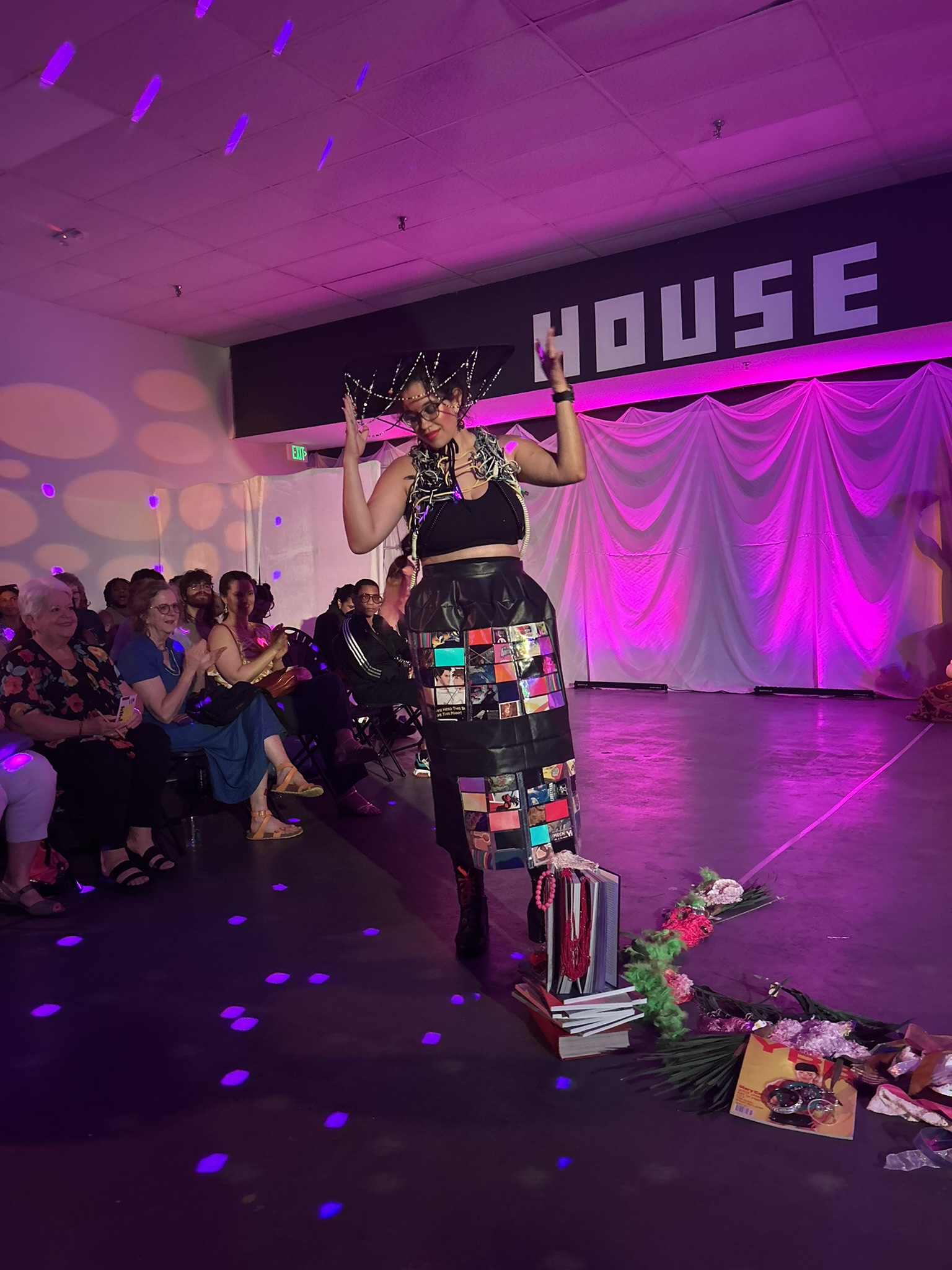
HOUSE OF SCRAP / PHOTOS BY FINN GILLAN
Kate Scheer modeled the trashion look, becoming Mangine’s “Queen of the Scrapyard.” Inspired by the giant mechanical suits of mecha anime, the look was cobbled together from different kinds of scrap. In Mangine’s imagined world, the mixture became an advantage, with different materials protecting her against the threats of a landscape shaped by pollution and environmental disaster.
Tobin Travis modeled the upcycling look, a master manipulator with a cybernetic spine that allowed him to change his size and stature and high-tech glasses that could detect biological responses. He builds new identities for himself out of discarded clothing.
Laila Major modeled the doll-core look, an enormously powerful marionette-inspired robot originally created by wealthy oil interests to reach beneath environmentally protected land. After gaining control of themself, Laila turns that same knowledge of rock, soil and ground toward creating sustainable farms in disenfranchised communities.
On June 7, 2025, “Reboot” reached the House of Scrap runway. Drag performers announced the show as Mangine’s three characters moved through the room before an audience that would ultimately decide the winner.
Mangine won.
The prize included six months of studio space at The Scrap Exchange and a gallery exhibition. Because regularly commuting to Durham did not make sense, Mangine declined the studio but kept the show.
It would take about a year for the exhibition to arrive. Mangine kept making in the meantime.
For “Symbiosis,” a two-look collection inspired by the relationship between pollinators and the plants they pollinate, Mangine returned to materials that had already exhausted their first purpose.
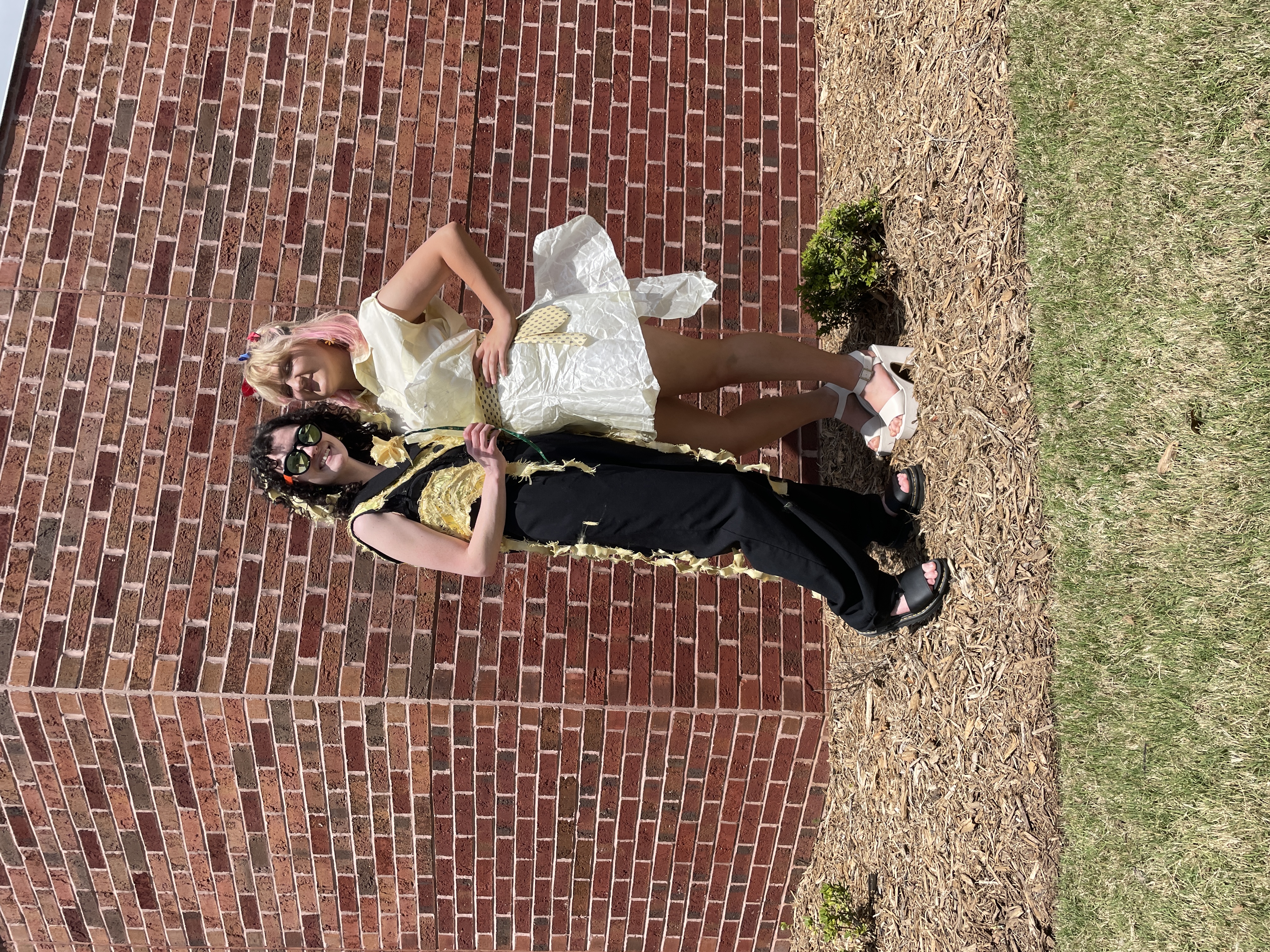
Lucy Payne modeled Pauleen, the pollinator. Yellow stripes of Kevlar across the suit came from a retired bulletproof vest belonging to Mangine’s uncle, a former police officer. Bulletproof vests are difficult to recycle and require specialized processing, leaving many of them destined for landfills.
Beside Pauleen stood May, modeled by Laurel Settlemire.
Flowers rested on wires beneath the outer layer of May’s dress. When that layer was untied and lowered, the flowers hinged outward, changing the silhouette as though the garment itself had been waiting to bloom.
Pauleen pollinates; May blooms. Mangine designed the pair around environmental collaboration, with each figure capable of creating something through the other.
By the time the House of Scrap prize finally became a gallery exhibition, “Reboot” and “Symbiosis” stood beside Feels Like a Sisphyian Task.
They do not match in the conventional sense. A bulletproof vest has little materially in common with a hard-lemonade can, and a tie pulled from a closet does not naturally belong beside Kevlar. One discarded material rarely appears in enough quantity for Mangine to repeat the same garment over and over.
What connects the pieces is story.
“All of the pieces that I have here have stories,” Mangine said. “That’s what the show is about, is storytelling and giving old materials a new story — a sequel.”
A previous life does not disappear when Mangine touches an object. It becomes the first chapter.
Mangine is not the only person in their family who has trouble leaving a scrap alone.
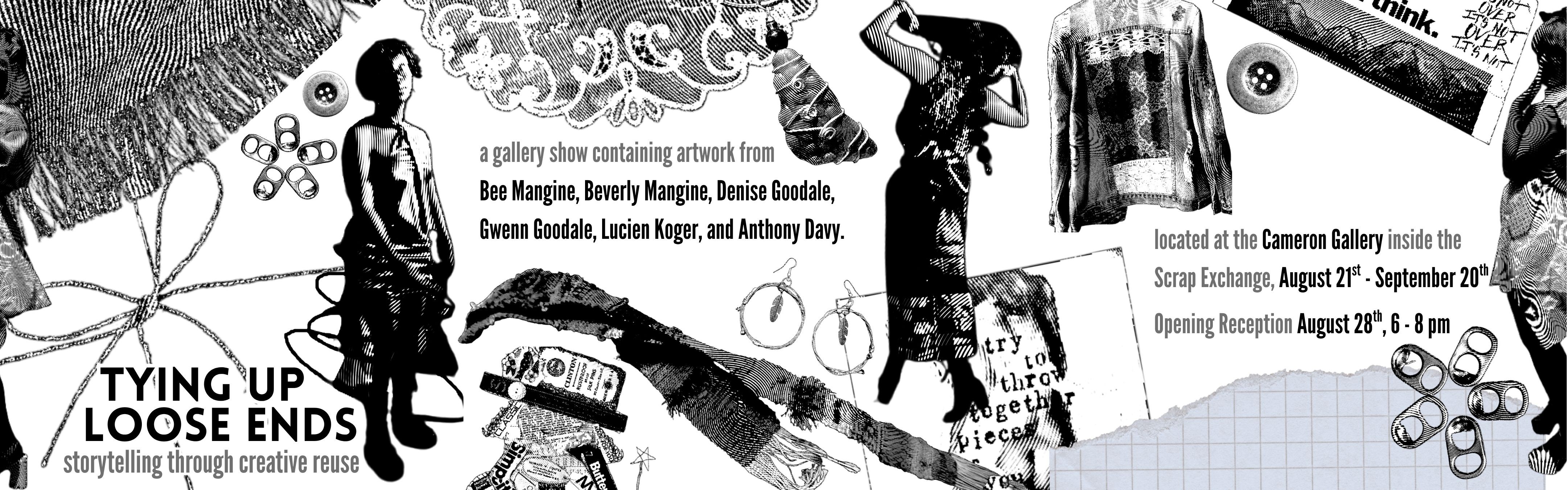
Both of their grandmothers have work in the gallery, and so does their mother. What looks at first like one designer’s exhibition begins to resemble something closer to a family archive.
Beverly Mangine, Bee’s grandmother, practices Saori weaving, a loose, free-form style that can absorb scraps into the weave rather than demanding identical material. Her scarves hang in the exhibition among Bee’s garments.
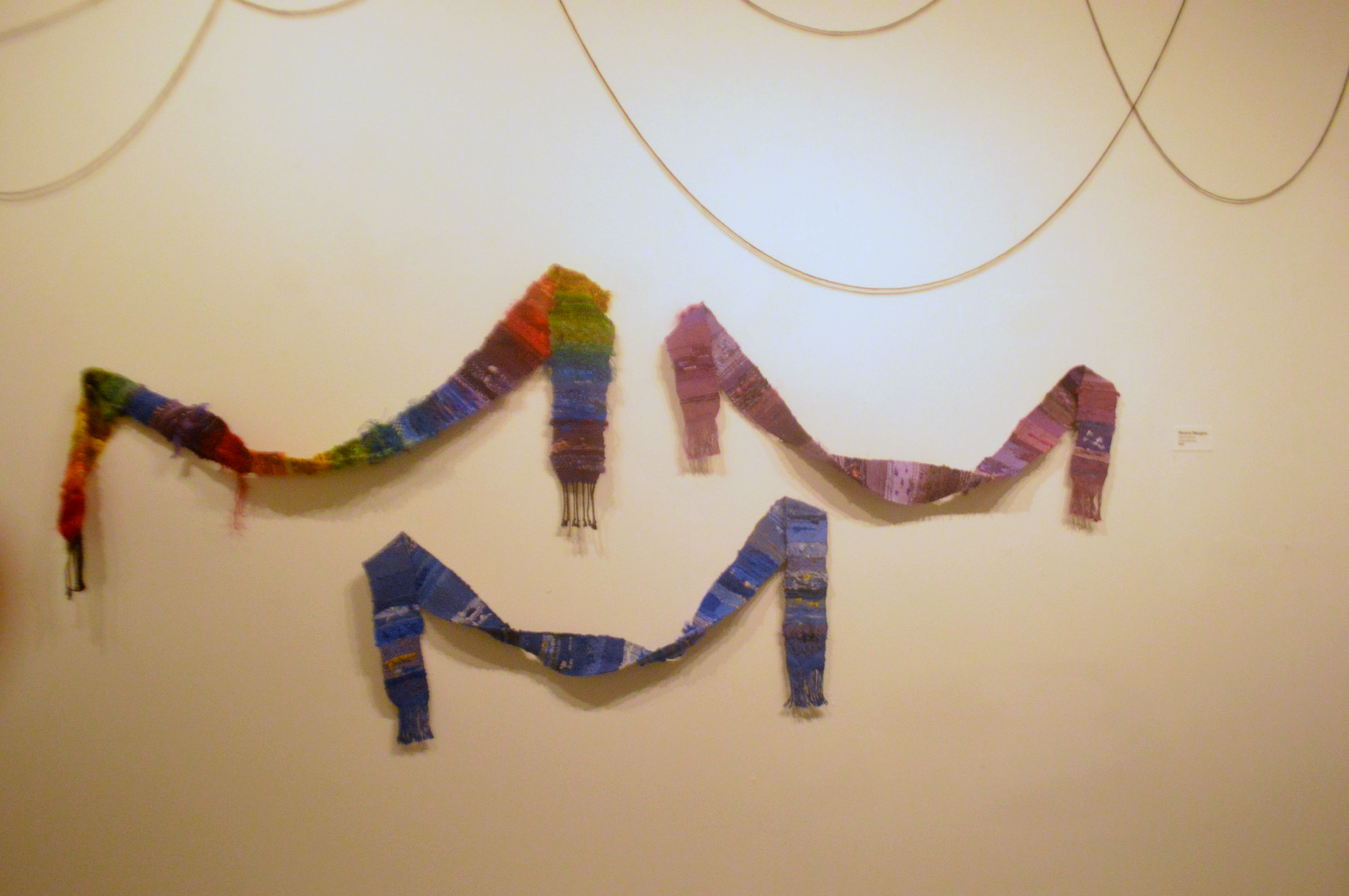
The instinct stretches beyond fabric.
As a child in Haiti, Mangine searched Jacmel Bay for sea glass, collecting fragments that had already been broken once and then softened by water until their edges no longer cut. Some became jewelry, and pieces Mangine made from the glass remain with their family.
Their grandmother Denise Goodale bends old guitar strings into jewelry rather than throwing them away when they can no longer be played. Mangine’s grandfather plays guitar.
Their mother, Gwenn, makes earrings that appear in the exhibition, too.
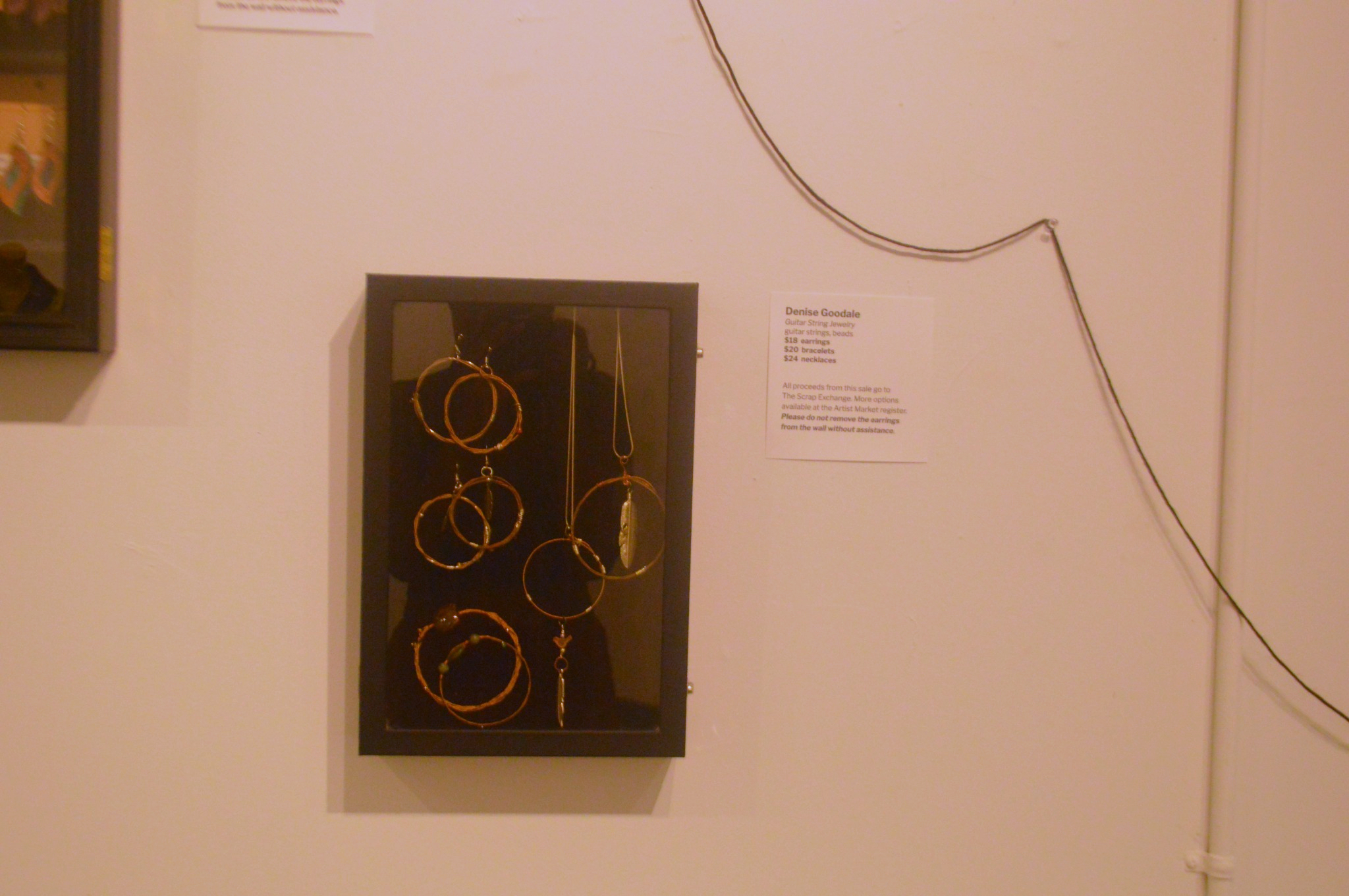
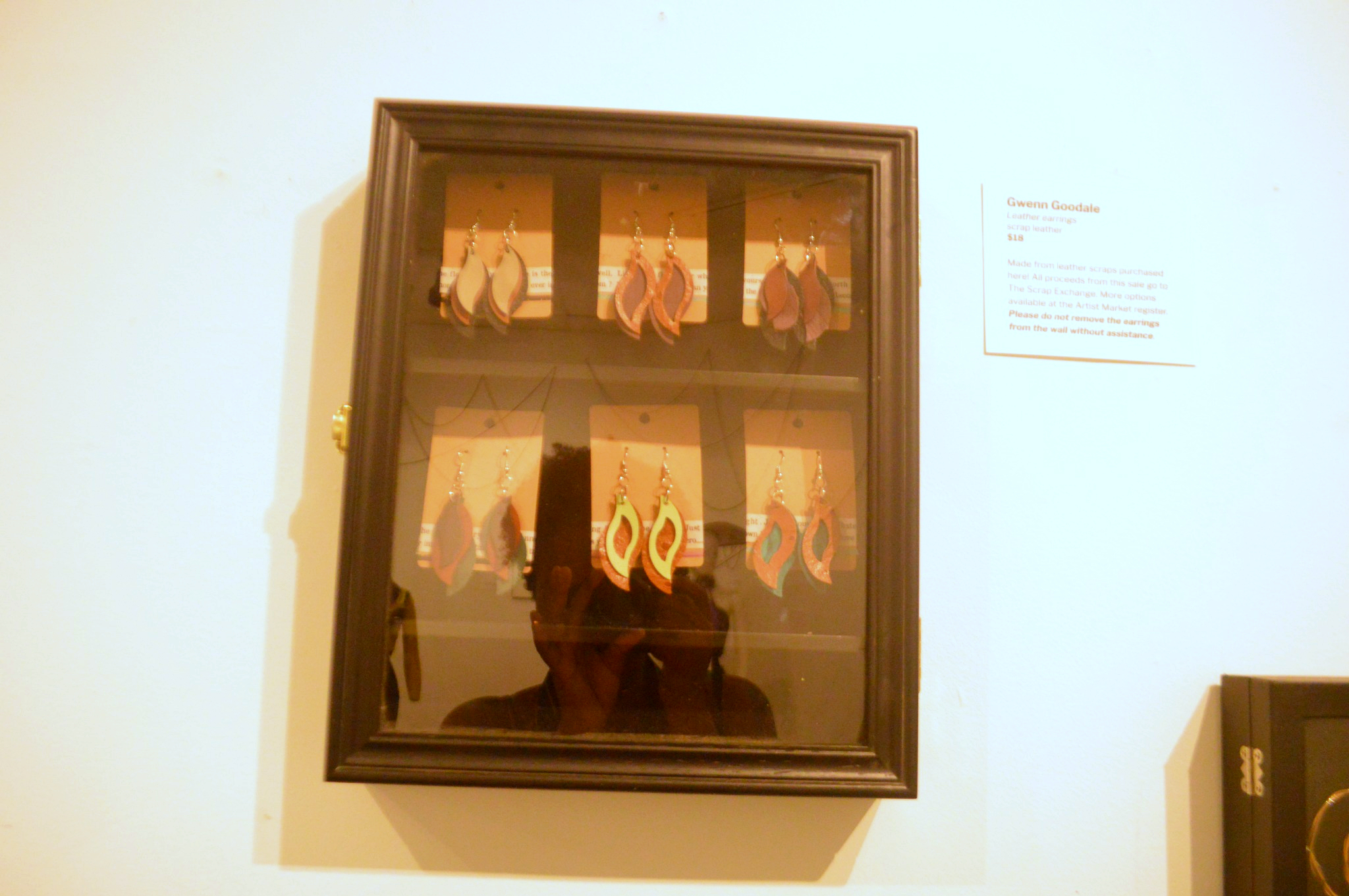
EXHIBITION PHOTOS BY SARAH MULU
Across the gallery, the materials change hands and generations. Beverly Mangine’s scraps disappear into the loose weave of a scarf. Denise Goodale bends old guitar strings into jewelry. Gwenn makes earrings. Bee cuts apart cans and neckties. Different hands, different materials, but the instinct is familiar: very little has to be finished simply because it has been used.
Some things get passed down less ceremoniously.
Mangine’s grandmother has one firm rule about sewing: Do not put pins in your mouth. She also has a habit of keeping pins in her mouth while she sews.
Once, while hanging something, she accidentally swallowed a small nail and ended up in the emergency room.
“So I’m built different,” Mangine joked.
Mangine now teaches some of those skills to another generation. At work, they teach children basic mending, and they have also helped lead a visible-mending workshop using clothing from The Scrap Exchange’s last-chance materials.
Visible mending leaves evidence. A contrasting thread can trace where fabric split; a patch can sit plainly over the place that wore thin. Repair does not have to return an object to what it looked like before.
Mangine’s garments rarely pretend otherwise. Kevlar still looks like Kevlar. Aluminum flashes beneath the remnants of its printing. A necktie can move from a collar to a skirt without disguising where it came from.
The old life stays visible inside the new one.
By the time I saw Mangine’s newest piece finished at The Scrap Exchange, the hard-lemonade cans were almost unrecognizable.
Almost.
The aluminum still behaved like aluminum.
“This stuff is very inflexible,” Mangine said while looking over the finished garment. Once it was on a body, they warned, it might need to be shifted and adjusted so it did not “poke or hurt.”
The ties had settled into a skirt, stretchy fabric formed the base of the top and a green tie folded backward into the halter, left recognizable on purpose. The thrifted necklace had also lost its original form; its chain now helped pull the top together.
And there, pressed into the aluminum, was Sisyphus.
During our earlier conversation, he had only been an idea, one Mangine was considering abandoning because it felt too bleak. Now his body leaned against the boulder, caught in the same impossible task Mangine had described before the piece was finished.
The aluminum process has continued beyond the gallery. Mangine adapted the technique for a workshop at The Scrap Exchange, where participants could use it to make keychains, and they began experimenting with a bolo-tie version.
The first attempt did not go particularly well.
“It looked kind of awful,” Mangine said. “But I’m gonna keep trying.”
The aluminum took an iron, a book and eventually an oven before it flattened. A tie had to be folded backward. A necklace had to come apart.
“Reuse is scary, and the way our planet is dying is scary,” Mangine said. “But then, from here, we gotta just move forward.”
So the boulder moves, and Mangine keeps pushing.